MCQ
For a reaction taking place in three steps at same temperature, overall rate constant $\mathrm{K}=\frac{\mathrm{K}_1 \mathrm{~K}_2}{\mathrm{~K}_3}$. If $\mathrm{Ea}_1, \mathrm{Ea}_2$ and $\mathrm{Ea}_3$ are $40$,$50$ and $60 \mathrm{~kJ} / \mathrm{mol}$ respectively, the overall $\mathrm{Ea}$ is ________ $\mathrm{kJ} / \mathrm{mol}$.
  • A
    $20$
  • B
    $10$
  • $30$
  • D
    $45$

Answer

Correct option: C.
$30$
c
$ \mathrm{K}=\frac{\mathrm{K}_1 \cdot \mathrm{K}_2}{\mathrm{~K}_3}=\frac{\mathrm{A}_1 \cdot \mathrm{A}_2}{\mathrm{~A}_3} \cdot \mathrm{e}^{-\frac{\left(\mathrm{E}_{\mathrm{a}_1}+\mathrm{E}_{\mathrm{a}_2}-\mathrm{E}_{\mathrm{a}_3}\right)}{R T}} $

$ \mathrm{~A} \cdot \mathrm{e}^{-\mathrm{E}_{\mathrm{a}} / \mathrm{RT}}=\frac{\mathrm{A}_1 \mathrm{~A}_2}{\mathrm{~A}_3} \cdot \mathrm{e}^{-\frac{\left(\mathrm{E}_{\mathrm{a}_1}+\mathrm{E}_{\mathrm{a}_2}-\mathrm{E}_{\mathrm{a}_3}\right)}{R T}}$

$\mathrm{E}_{\mathrm{a}}=\mathrm{E}_{\mathrm{a}_1}+\mathrm{E}_{\mathrm{a}_2}-\mathrm{E}_{\mathrm{a}_3}=40+50-60=30 \mathrm{~kJ} / \mathrm{mole}$

Need a full question paper?

Generate a complete, print-ready paper with questions like this in minutes — across 16+ boards, with answer keys.

Start Generating Free

Similar questions

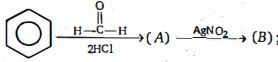
Product $(B)$ of the reaction is
Given below are two statements: One is labelled as $A$ssertion $A$ and the other is labelled as $R$eason $R$:

Assertion $A$: $\mathrm{pK}_{\mathrm{a}}$ value of phenol is $10.0$ while that of ethanol is $15.9$.

Reason $R$: Ethanol is stronger acid than phenol.In the light of the above statements, choose the correct answer from the options given below:

In which of following there exists a $p\pi - d\pi $ bonding
The nitrogen oxide(s) that contain$(s)$ $\mathrm{N}-\mathrm{N}$ bond$(s)$ is$(are)$

$(A)$ $\mathrm{N}_2 \mathrm{O}$ $(B)$ $\mathrm{N}_2 \mathrm{O}_3$ $(C)$ $\mathrm{N}_2 \mathrm{O}_4$ $(D)$ $\mathrm{N}_2 \mathrm{O}_5$

Which one of the following conditions will favour maximum formation of the product in the reaction

$\mathrm{A}_{2}(\mathrm{g})+\mathrm{B}_{2}(\mathrm{g}) \rightleftharpoons \mathrm{X}_{2}(\mathrm{g}) \Delta_{r} \mathrm{H}=-\mathrm{X} \mathrm{kJ} ?$

For diatomic molecules, the correct statement($s$) about the molecular orbitals formed by the overlap to two $2 p_z$ orbitals is(are)

$(A)$ $\sigma$ orbital has a total of two nodal planes.

$(B)$ $\sigma^*$ orbital has one node in the $x z$-plane containing the molecular axis.

$(C)$ $\pi$ orbital has one node in the plane which is perpendicular to the molecular axis and goes through the center of the molecule.

$(D)$ $\pi^*$ orbital has one node in the $x y$-plane containing the molecular axis.

Ionisation energy of $He^+$ is $19.6\times 10^{-18} \,J\,atom^{-1}.$ The energy of the first stationary state $(n = 1)$ of $ Li^{+2}$ is
Which of the following compound show sublimation
The entropy change, in the conversion of one mole of liquid water at $373 \,K$ to vapour at the same temperature is (Latent heat of vaporization of water, $\Delta {H_{vap}} = 2.257\,kJ/g)$ ........$J\,{k^{ - 1}}$
The number of electrons in $C{l^ - }$ ion is