Question
For a real object, which of the following can produced a real image

Answer

Concave mirror has reflecting surface bulged inwards which converge the incident light rays, from real objects, to meet at a point after reflecting from the concave mirror. The reflected rays converge to produce a real image provided real object is not placed between Focus and Pole.

Need a full question paper?

Generate a complete, print-ready paper with questions like this in minutes — across 16+ boards, with answer keys.
Start Generating Free

Similar questions

A particle of mass $m$ moving eastward with a speed $v$ collides with another particle of the same mass moving northwards with same speed $v$. The two particles coalesce on collision. The new particle of mass $2 \,m$ will move with velocity
The ratio of maximum acceleration to maximum velocity in a simple harmonic motion is $10\,s^{-1}$.  At, $t = 0$ the displacement is $5\, m$. What is the maximum acceleration ? The initial phase is $\frac{\pi }{4}$
A man fires a bullet of mass $200 \,g$ at a speed of $5 \,m/s$. The gun is of one $kg$ mass. by what velocity the gun rebounds backwards ........ $m/s$
A cylinder contains $10\, kg$ of gas at pressure of ${10^7}\,\,N/{m^2}.$ The quantity of gas taken out of the cylinder, if final pressure is $2.5 \times {10^6}\,N/{m^2},$ will be ..... $kg$ (Temperature of gas is constant)
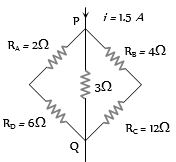
Potential difference between the points $P$ and $Q$ in the electric circuit shown is ................. $V$
One second is equal to
Radius of a circular loop placed in a perpendicular uniform magnetic field is increasing at a constant rate of $r_0 ms ^{-1}$. If at any instant radius of the loop is $r$, then emf induced in the loop at that instant will be
A body covers first one-third of the distance with a velocity $20\, ms^{-1}$, the second one-third with a velocity of $30\, ms^{-1}$ and last one-third with a velocity of $40\, ms^{-1}$. The average velocity is nearly........$m/s$
A chain is on a frictionless table with one fifth of its length hanging over the edge. If the chain has length $L$ and mass $M$, the work required to be done to pull the hanging part back onto the table is
A constant torque acting on a uniform circular wheel changes its angular momentum from $A_0$ to $4A_0$ in $4\, second$. The magnitude of this toque is