MCQ
For a satellite if the time of revolution is $T$, then its $K.E.$ is proportional to
  • A
    $\frac{1}{T}$
  • B
    $\frac{1}{T^2}$
  • C
    $\frac{1}{T^3}$
  • $T^{-2/3}$

Answer

Correct option: D.
$T^{-2/3}$
d
$\mathrm{kE}=\frac{\mathrm{GMm}}{2 \mathrm{r}}$

$\mathrm{kE} \propto \frac{1}{\mathrm{r}} \alpha \mathrm{T}^{\frac{-2}{3}}$

$\because\left(\mathrm{T}^{2} \alpha \mathrm{r}^{3}\right)$

Need a full question paper?

Generate a complete, print-ready paper with questions like this in minutes — across 16+ boards, with answer keys.
Start Generating Free

Similar questions

Which of the following measurement is more accurate?
The lower surface of a cube is fixed. On its upper surface, force is applied at an angle of $30°$ from its surface. The change will be of the type
There is a $1$ $mm $ thick layer of glycerine between a flat plate of area $100$ $cm^2$ $\&$ a big fixed plate. If the coefficient of viscosity of glycerine is $1.0$ $kg/m^{-s}$ then ....... $N$ force is required to move the plate with a velocity of $7$ $cm/s$ ?
Elasticity is shown by materials because inter$-$atomic or inter$-$molecular forces:
Between the two stations a train accelerates uniformly at first, then moves with constant velocity and finally retards uniformly. If the ratio of the time taken be $1 : 8 : 1$ and the maximum speed attained be $60\,km/h,$ then what is the average speed over the whole journey.......$km/h$
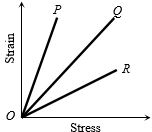
The strain-stress curves of three wires of different materials are shown in the figure. $P, Q$ and $R$ are the elastic limits of the wires. The figure shows that
A solid cylinder is placed on a rough surface of inclination $\theta $ , minimum value of coefficient of static friction between the cylinder and the surface so that the cylinder roll's without slipping is
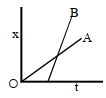
The position-time graphs for two students $A$ and $B$ returning from the school to their homes are shown in figure

$(A)$ $A$ lives closer to the school

$(B)$ $B$ lives closer to the school

$(C)$ $A$ takes lesser time to reach home

$(D)$ $A$ travels faster than $B$

$(E)$ $B$ travels faster than $A$

Choose the correct answer from the options given below :
The coefficient of linear expansion of crystal in one direction is ${\alpha _1}$ and that in every direction perpendicular to it is ${\alpha _2}$. The coefficient of cubical expansion is
The force required to row a boat at constant velocity is proportional to square of its speed. If a speed of $v$ $km / h$ requires $4 \,kW$, how much power does a speed of $2 v\; km / h$ require is ........... $kW$