MCQ
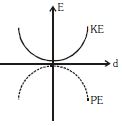
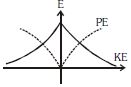
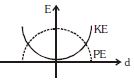
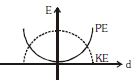
For a simple pendulum, a graph is plotted between its kinetic energy $(KE)$ and potential energy $(PE)$ against its displacement $d.$ Which one of the following represents these correctly ? (graphs are schematic and not drawn to scale)
  • A


  • C

  • D

Answer

Correct option: B.

b

Need a full question paper?

Generate a complete, print-ready paper with questions like this in minutes — across 16+ boards, with answer keys.
Start Generating Free

Similar questions

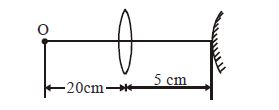
A convex lens of focal length $15\,cm$ is placed in front of a convex mirror. When the object is placed at $O$ , the image coincides with it. The radius of curvature of mirror is.....$cm$
The balancing length for a cell is $560 \;\mathrm{cm}$ in a potentiometer experiment. When an external resistance of $10 \;\Omega$ is connected in parallel to the cell, the balancing length changes by $60\; \mathrm{cm} .$ If the internal resistance of the cell is $\frac{\mathrm{N}}{10} \;\Omega,$ where $\mathrm{N}$ is an integer then value of $\mathrm{N}$ is
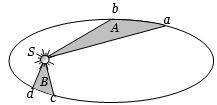
The figure shows the motion of a planet around the sun in an elliptical orbit with sun at the focus. The shaded areas $A$ and $B$ are also shown in the figure which can be assumed to be equal. If ${t_1}$ and ${t_2}$ represent the time for the planet to move from $a$ to $b$ and $d$ to $c$ respectively, then
A particle is moving along a circular path with a constant speed of $10\ ms^{-1}.$ What is the magnitude of the change in velocity of the particle, when it moves through an angle of $60^{o}$ around the centre of the circle $.......... m/s$
Latent heat of $1\,gm $ of steam is $536 \,cal/gm,$ then its value in $joule/kg$ is
In the absence of other conductors, the surface charge density
Electrons moving with different speeds enter a uniform magnetic field in a direction perpendicular to the field., time periods of rotation will be :
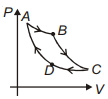
Carnot cycle is plotted in $P-V$ graph. Which portion represents an isothermal expansion?
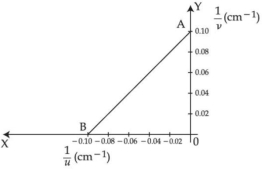
The graph between $\frac{1}{ u }$ and $\frac{1}{ v }$ for a thin convex lens in order to determine its focal length is plotted as shown in the figure. The refractive index of length is $1.5$ and its both the surfaces have same radius of curvatures $R$. The value of $R$ will be $cm$

(Where $u =$ object distance, $v =$ image distance)
Given below are two statements: One is labelled as Assertion $A$ and the other is labelled as Reason $R$.

Assertion $A$ : Product of Pressure $(P)$ and time $(t)$ has the same dimension as that of coefficient of viscosity.

Reason $R$ : Coefficient of viscosity $=\frac{\text { Force }}{\text { Velocity gradient }}$

Question : Choose the correct answer from the options given below