Question
For a solid with a small expansion coefficient:
  1. Cp - Cv = R
  2. Cp = Cv
  3. Cp is slightly greater than Cv
  4. Cp is slightly less than Cv

Answer

  1. Cp is slightly greater than Cv

Explanation:

For a solid with a small expansion coefficient, work done in a process will also be small. Thus, the specific heat depends slightly on the process. Therefore, Cp is slightly greater than Cv.

Need a full question paper?

Generate a complete, print-ready paper with questions like this in minutes — across 16+ boards, with answer keys.
Start Generating Free

Similar questions

A train moving towards a hill at a speed of $72\ km/hr$ sounds a whistle of frequency $500\ Hz$ . A wind is blowing from the hill at a speed of $36\ km/hr$ . If the speed of sound in air is $340\ m/s$ , the frequency heard by a man on the hill (nearly) is ... $Hz$
A transverse harmonic wave on a string is described by $\text{y}(\text{x},\text{t})=3.0\sin(36\ \text{t}+0.018\text{x}+\pi/ 4)$ where x and y are in cm and t is in s. The positive direction of x is from left to right.
The excess pressure inside a soap bubble is twice the excess pressure inside a second soap bubble. The volume of the first bubble is n times the volume of the second where n is:
  1. 4
  2. 2
  3. 1
  4. 0.125.
To raise the temperature of a certain mass of gas by $50^{\circ} C$ at a constant pressure, $160$ calories of heat is required. When the same mass of gas is cooled by $100^{\circ} C$ at constant volume, $240$ calories of heat is released. How many degrees of freedom does each molecule of this gas have (assume gas to be ideal) $?$
If the amount of heat given to a system be $35$ joules and the amount of work done by the system be $ - 15$ joules, then the change in the internal energy of the system is .... $joules$
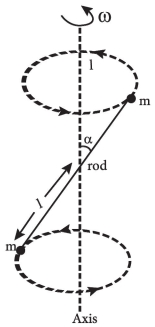
A massless rod $S$ having length $2I$ has equal point masses attached to its two ends as shown in figure. The rod is rotating about an axis passing through its centre and making angle $\alpha$ with the axis. The magnitude of change of momentum of rod i.e. $\left|\frac{ dL }{ dt }\right|$ equals
The type of waves that can be propagated through solid is
The phase difference between the instantaneous velocity and acceleration of a particle executing simple harmonic motion is
$Assertion$ : A rocket moves forward by pushing the surrounding air backwards.

$Reason$ : It derives the necessary thrust to move forward according to Newton’s third law of motion

Two different wires having lengths $L _{1}$ and $L _{2}$ and respective temperature coefficient of linear expansion $\alpha_{1}$ and $\alpha_{2},$ are joined end-to-end. Then the effective temperature coefficient of linear expansion is