Question
For a spherical shell

Answer

Get the step-by-step solution for this question inside the Vidyadip app.

Get the answer in the app

Need a full question paper?

Generate a complete, print-ready paper with questions like this in minutes — across 16+ boards, with answer keys.
Start Generating Free

Similar questions

When the angle of incidence is $60^o$ on the surface of a glass slab, it is found that the reflected ray is completely polarized. The velocity of light in glass is
A compass needle of oscillation magnetometer oscillates $20$ times per minute at a place $P$ of dip $30^{\circ}$. The number of oscillations per minute become $10$ at another place $Q$ of $60^{\circ} dip$. The ratio of the total magnetic field at the two places $\left(B_{Q}: B_{p}\right)$ is.
Force on current carrying loop (Radius $= R$ ) in uniform magnetic $(B)$ field which is at an angle $30^{\circ}$ with the normal will be
Inductance $L$ can be dimensionally represented as
In carbon monoxide molecules, the carbon and the oxygen atoms are separated by distance $1.2 \,\mathring A$. The distance of the centre of mass, from the carbon atom is ........  $\mathring A$
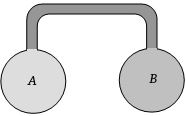
Two spherical vessel of equal volume, are connected by a n arrow tube. The apparatus contains an ideal gas at one atmosphere and $300K$. Now if one vessel is immersed in a bath of constant temperature $600K$ and the other in a bath of constant temperature $300K$. Then the common pressure will be ...... $atm$
Which one of the following spherical lenses does not exhibit dispersion? The radii of curvature of the surfaces of the lenses are as given in the diagrams
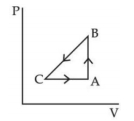
A sample of an ideal gas is taken through the cyclic process $ABCA$ as shown in figure. It absorbs, $40\,J$ of heat during the part $A B$, no heat during $BC$ and rejects $60\,J$ of heat during $CA$. $A$ work $50\,J$ is done on the gas during the part $BC$. The internal energy of the gas at $A$ is $1560\,J$. The work done by the gas during the part $CA$ is.............$J$
A galaxy is observed to be moving with a velocity of $8600 km-sec^{-{1}}$. If it is at a distance of $430$ million light year from us, Hubble constant and corresponding age of the universe are respectively
In solids, inter-atomic forces are