MCQ
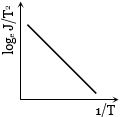
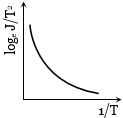
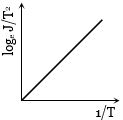
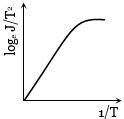
For a thermionic emitter (metallic) if J represents the current density and T is its absolute temperature then the correct curve between ${\log _e}\frac{J}{{{T^2}}}$ and $\frac{1}{T}$ is

  • B

  • C

  • D

Answer

Correct option: A.

a
(a)According to Richardson-Dushman equation $J = A{T^2}{e^{ - b/T}}$
Taking log of this equation ${\log _e}\frac{J}{{{T^2}}} = {\log _e}A - \frac{b}{T}$
i.e. graph between ${\log _e}\frac{J}{{{T^2}}}$ and $\frac{1}{T}$ will be a straight line having negative slope and positive intercept $(logeA)$  on ${\log _e}\frac{J}{{{T^2}}}{\rm{axis}}{\rm{.}}$

Need a full question paper?

Generate a complete, print-ready paper with questions like this in minutes — across 16+ boards, with answer keys.
Start Generating Free

Similar questions

Two capacitors $C_1$ and $C_2 = 2C_1$ are connected in a circuit with a switch between them as shown in the figure. Initially the switch is open and $C_1$ holds charge $Q$. The switch is closed. At steady state, the charge on each capacitor will be
Considering a group of positive charges, which of the following statements is correct?
A transistor is used in an amplifier circuit in common emitter mode. If the base current changes by $100 \,\mu A$, it brings a change of $10 \,mA$ in collector current. If the load resistance is $2 \,k \Omega$ and input resistance is $1 \,k \Omega$, the value of power gain is $x \times 10^{4}$. The value of $x$ is_________
When a current of $2\,A$ flows in a battery from negative to positive terminal, the potential difference across it is $12\,V$. If a current of $3\,A$ flows in the opposite direction potential difference across the terminals of the battery is $15\,V$, the emf of the battery is ............... $\mathrm{V}$
In insulator:
One requires energy $E_n$ to remove a nucleon from a nucleus and an energy ' $E_e{ }^{\prime}$ to remove an electron from the orbit of an atom. Then
A photon in motion has a mass
Which is the correct relation for forbidden energy gap in conductor, semi conductor and insulator
The dotted part of the lens is cut and kept on the $x$ axis as shown in the diagram. If parallel paraxial rays are falling on this systems then the coordinate of image  formed after refraction  from both the lenses is $(30, -1)$ . If $x = 2.5$ then $y=..........cm$ (all the distance is in cm) (Assume lens have no spherical aberration)
The three resistance of equal value are arranged in the different combinations shown below. Arrange them in increasing order of power dissipation.