MCQ
For a very dilute solution of H3​PO3​ van't Hoff factor is:
  • A
    i = 7
  • B
    i = 3
  • C
    i = 4
  • D
    i = 5

Answer

  1. i = 3

Need a full question paper?

Generate a complete, print-ready paper with questions like this in minutes — across 16+ boards, with answer keys.

Start Generating Free

Similar questions

$p$-Amino- $N, N$-dimethylaniline is added to a strongly acidic solution of ${X}$. The resulting solution is treated with a few drops of aqueous solution of ${Y}$ to yield blue coloration due to the formation of methylene blue. Treatment of the aqueous solution of ${Y}$ with the reagent potassium hexacyanoferrate$(II)$ leads to the formation of an intense blue precipitate. The precipitate dissolves on excess addition of the reagent. Similarly, treatment of the solution of ${Y}$ with the solution of potassium hexacyanoferrate$(III)$ leads to a brown coloration due to the formation of ${Z}$.

$1.$ The compound ${X}$ is

$(A)$ $\mathrm{NaNO}_3$ $(B)$ $\mathrm{NaCl}$ $(C)$ $\mathrm{Na}_2 \mathrm{SO}_4$ $(D)$ $\mathrm{Na}_2 \mathrm{~S}$

$2.$ The compound ${Y}$ is

$(A)$ $\mathrm{MgCl}_2$ $(B)$ $\mathrm{FeCl}_2$ $(C)$ $\mathrm{FeCl}_3$ $(D)$ $\mathrm{ZnCl}_2$

$3.$ The compound ${Z}$ is

$(A)$ $\left.\mathrm{Mg}_2 \mid \mathrm{Fe}(\mathrm{CN})_6\right]$ $(B)$ $\operatorname{Fe}\left[\mathrm{Fe}(\mathrm{CN})_6\right]$

$(C)$ $\mathrm{Fe}_4\left[\mathrm{Fe}(\mathrm{CN})_6\right]_3$ $(D)$ $\mathrm{K}_2 \mathrm{Zn}_3\left[\mathrm{Fe}(\mathrm{CN})_6\right]_2$

Give the answer question $1,2$ and $3.$
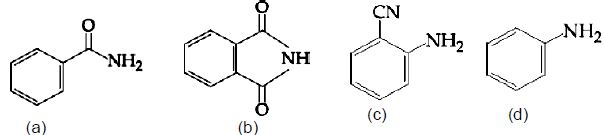
Which of the following compounds does not react with $NaN{O_2}$ and $HCl$
Which of the following is not correct regarding the structure of $POCl_3$
The increasing order of reactivity of the following compounds towards reaction with alkyl halide directly is
Product $Z$ of above reaction is
Oxidation of toluene to Benzaldehyde can be easily carried out with which of the following reagents?
Which of the following is formed by the action of water on sodium peroxide
If decomposition reaction $A(g) \to B(g)$ follows first order kinetics then the graph of rate of formation $(R)$ of $B$ against time $t$ will be
The product of partial hydrolysis with heavy water of $PCl_5$ is 
Which of the following is wrong statement
