Question
For $AB$ bond if percent ionic character is plotted against electronegativity difference $(X_A -X_B),$ the shape of the curve would look like The correct curve is
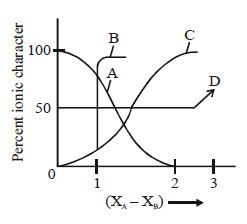
$\Delta E . N .=1.7 \Rightarrow 50\,\%$ ionic and $50 \,\%$ covalent
$\Delta E . N .\,>\,1.7 \Rightarrow$ more than $50\, \%$ ionic and less than $50 \,\%$ covalent
$\Delta E . N .\,<\,1.7 \Rightarrow$ less than $50\, \%$ ionic and more than $50\, \%$ covalent
Generate a complete, print-ready paper with questions like this in minutes — across 16+ boards, with answer keys.
$(I)$ They have high melting points, higher than those of pure metals
$(II)$ They are very hard
$(III)$ They retain metallic conductivity
$(IV)$ They are chemically more reactive than the pure metals
$CH_3-CH_2-OH$ $\mathop {\xrightarrow{{(i)\,KMn{O_4}/\mathop O\limits^\Theta H/\Delta }}}\limits_{(ii)\,{H^ \oplus }} (A)\mathop {\xrightarrow{{(i)\,SOC{l_2}}}}\limits_{(ii)\,N{H_3}/\Delta } (B)$ $\xrightarrow{{B{r_2}/KOH}}(C)$
$(C)$ will be :