MCQ
For an amplitude modulated wave the minimum amplitude is $3\,V$, while the modulation index is $60 \%$. The maximum amplitude of the modulated wave is $......\,V$
  • A
    $15$ $V$
  • $12$ $V$
  • C
    $10$ $V$
  • D
    $5$ $V$

Answer

Correct option: B.
$12$ $V$
b
Modulation index $=\frac{A_w}{A_c}=0.6$

Minimum amplitude of modulated wav $=A_c-A_w=3$

$\therefore A_c-0.6 A_c=3 \Rightarrow 0.4 A_c=3$

$A_c=\frac{3}{0.4}=\frac{15}{2}=7.5\,V$

$A_w=0.6 A_c=4.5\,V$

$\therefore$ Maximum amplitude $= A _{ c }+ A _{ m }$

$=7.5+4.5=12\,V$

Need a full question paper?

Generate a complete, print-ready paper with questions like this in minutes — across 16+ boards, with answer keys.
Start Generating Free

Similar questions

What $kV$ potential is to be applied on $X-$ ray tube so that minimum wavelength of emitted $X-$ rays may be $1Å$......$kV$ ($h = 6.625 \times {10^{ - 34}}J-sec$)
A conducting circular loop is placed in a uniform magnetic field $0.04\,\,T$ with its plane perpendicular to the magnetic field. The radius of the loop starts shrinking at $2\,\,mm/s$ . The induced $emf$ in the loop when the radius is $2\,\,cm$ is
A person travelling on a straight line moves with a uniform velocity $v_1$ for a distance x and with a uniform velocity $v_2$ for the next equal distance. The average velocity v is given by:
A solid sphere, a hollow sphere and a disc, all having same mass and radius, are placed at the top of an incline and released. The friction coefficients between the objects and the incline are same and not sufficient to allow pure rolling. Least time will be taken in reaching the bottom by:
An electron is moving with a speed of ${10^8}\,m/\sec $ perpendicular to a uniform magnetic field of intensity $B$. Suddenly intensity of the magnetic field is reduced to $B/2$. The radius of the path becomes from the original value of $r$
A proton moving with a velocity, $2.5 \times {10^7}\,m/s$, enters a magnetic field of intensity $2.5\,T$ making an angle ${30^o}$ with the magnetic field. The force on the proton is
New SI unit of mass $1 \,kg$ is defined in terms of the difference in the masses of two ${ }^{133} Cs _{55}$ atoms. One of these atoms is in its ground state and the other in an excited state that has frequency of excitation close to $9.2 \times 10^9 \,Hz$. Number of atoms required to get $1 \,kg$ of mass this way is the order of (Planck's constant = $6.63 \times 10^{-34} \,J s ;$ mass of proton $=1.67 \times 10^{-27}$ $kg$; Avogadro number $=6.02 \times 10^{23}$ particles; speed of light $=3 \times 10^8 \,m / s$ )
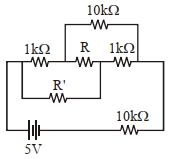
When the resistance $R$ (indicated in the figure below) is changed from $1 \,k \Omega$. to $10 \,k \Omega$, the current flowing through the resistance $R'$ does not change. What is the value of the resistor $R'?$
A plane electromagnetic wave is incident on a material surface. If the wave delivers momentum $p$ and energy $E$, then
When the current in a coil changes from 8 ampere to 2 ampere in $3 \times 10^{-2}$ second, the e.m.f. induced in the coil is 2 volt. The self inductance of the coil (in millihenry) is