Question
For an equilateral prism, it is observed that when a ray strikes grazingly at one face it emerges grazingly at the other. Its refractive index will be

Answer

$\mathrm{i}_{1}=\mathrm{i}_{2}=90^{\circ}, \mathrm{r}_{1}=\mathrm{r}_{2}=\frac{\mathrm{A}}{2}=30^{\circ}$

$\mu=\frac{\sin \mathrm{i}_{1}}{\sin \mathrm{r}_{1}}=2$

Need a full question paper?

Generate a complete, print-ready paper with questions like this in minutes — across 16+ boards, with answer keys.

Start Generating Free

Similar questions

Assertion : Newton’s rings are formed in the reflected system when the space between the lens and the glass plate is filled with a liquid of refracitve index greater than that of glass, the central spot of the pattern is bright.

Reason : This is because the reflection in these cases will be from a denser to rarer medium and the two interfering rays are reflected under similar conditions.

The binding energy per nucleon of $Li$ and $He$ nuclei are $5.60\,\,MeV$ and $7.06\,\,MeV$ respectively In the nuclear reaction 

${}_3^7Li$ + ${}_1^1H  \to $ $2{}_2^4He$ $+Q$ 

the value of enery $Q$ released is.........$MeV$
Monochromatic light passes through a prism. Compared to that in air, inside the prism the light's
The ratio of the shortest wavelength of Balmer series to the shortest wavelength of Lyman series for hydrogen atom is :
In a Young's double slit experiment if there is no initial phase difference between the light from the two slits, a point on the screen corresponding to the fifth minimum has path difference
Average density of the earth 
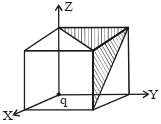
A charge $'q'$ is placed at one corner of a cube as shown in figure. The flux of electrostatic field $\overrightarrow{ E }$ through the shaded area is ...... .
Every series of hydrogen spectrum has an upper and lower limit in wavelength. The spectral series which has an upper limit of wavelength equal to $18752 Å$ is

(Rydberg constant $R = 1.097 \times {10^7}$per metre)

The electric field in a region of space is given by, $\overrightarrow E  = {E_0}\hat i + 2{E_0}\hat j$ where $E_0\, = 100\, N/C$. The flux of the field through a circular surface of radius $0.02\, m$ parallel to the $Y-Z$ plane is nearly
In order to see diffraction the thickness of the film is