MCQ
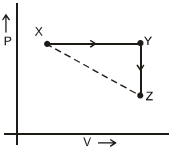
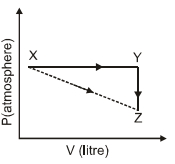
For an ideal gas, consider only $P - V$ work in going from an initial state $X$ to the final stat $Z$. The final state $Z$ can be reached by either of the two paths shown in the figure. Which of the following choice$(s)$ is (are) correct? [take $\Delta S$ as change in entropy and w as work done].

$(A)$ $\Delta S _{ x \rightarrow z}=\Delta S _{ x \rightarrow y}+\Delta S _{ y \rightarrow z}$

$(B)$ $w_{x \rightarrow z}=w_{x \rightarrow y}+w_{y \rightarrow z}$

$(C)$ $w_{x \rightarrow z \rightarrow z}=w_{x \rightarrow y}$

$(D)$ $\Delta S _{x \rightarrow y \rightarrow z}=\Delta S _{x \rightarrow y}$
  • A
    $(A,C)$
  • B
    $(B,C)$
  • C
    $(A,D)$
  • D
    $(C,D)$

Answer

$(A)$ $\Delta S_{x \rightarrow z}=\Delta S_{x-y}+\Delta S_{y \rightarrow z}$

(Correct)

$(B)$ $W _{x \rightarrow y}= W _{x-y}+ W _{ y \rightarrow z }$

(Incorrect)

$(C)$ $W _{x \rightarrow y \rightarrow z}= W _{x-y}$

(Correct)

$(D)$ $\Delta S _{x \rightarrow j \rightarrow z}=\Delta S _{x-y}$

(Incorrect)

Need a full question paper?

Generate a complete, print-ready paper with questions like this in minutes — across 16+ boards, with answer keys.

Start Generating Free

Similar questions

At constant pressure and temperature, the direction to the result of any chemical reaction is where, there is less amount of
An amount of solid $N{H_4}HS$ is placed in a flask already containing ammonia gas at a certain temperature and $0.50$ $atm.$ pressure. Ammonium hydrogen sulphide decomposes to yield $N{H_3}$ and ${H_2}S$ gases in the flask. When the decomposition reaction reaches equilibrium, the total pressure in the flask rises to $0.84$ $atm$. The equilibrium constant for $N{H_4}HS$ decomposition at this temperature is
A solution containing $N{a_2}C{O_3}$ and $NaOH$ requires $300\, ml$ of $0.1\, N$ $HCl$ using phenolpthalein as an indicator. Methyl orange is then added to the above titrated solution when a further $25\, ml$ of $0.2\, N$ $HCl$ is required. The amount of $NaOH$ present in solution is  ................. $\mathrm{g}$  $(NaOH = 40,\,N{a_2}C{O_3} = 106)$
Curved arrows are used in Organic Chemistry to show the movement of electrons in the mechanism of a reaction. The correct product of the following reaction is
Methylation of $10\, \mathrm{~g}$ of benzene gave $9.2\, \mathrm{~g}$ of toluene. Calculate the percentage yield of toluene $......$. (Nearest integer)
Which one does not give cannizzaro's reaction
The correct order of the complexes $\left[ Co \left( NH _3\right)_5\left( H _2 O \right)\right]^{3+} \quad( A ), \quad\left[ Co \left( NH _3\right)_6\right]^{3+}$ $\left[ Co ( CN )_6\right]^{3-}( C )$ and $\left[ CoCl \left( NH _3\right)_5\right]^{2+}$ (D) in terms wavelength of light absorbed is :
How many atoms of calcium will be deposited from a solution of $CaC{l_2}$ by a current of $25$  milliamperes flowing for $60$  seconds
If $Br^-$ configuration is $[Ar]\, 3d^{10}\,4s^2\,4p^6$ then $Br^{+2}$ configuration will be identical to which element ?
Methyl isocyanide on hydrolysis gives