Question
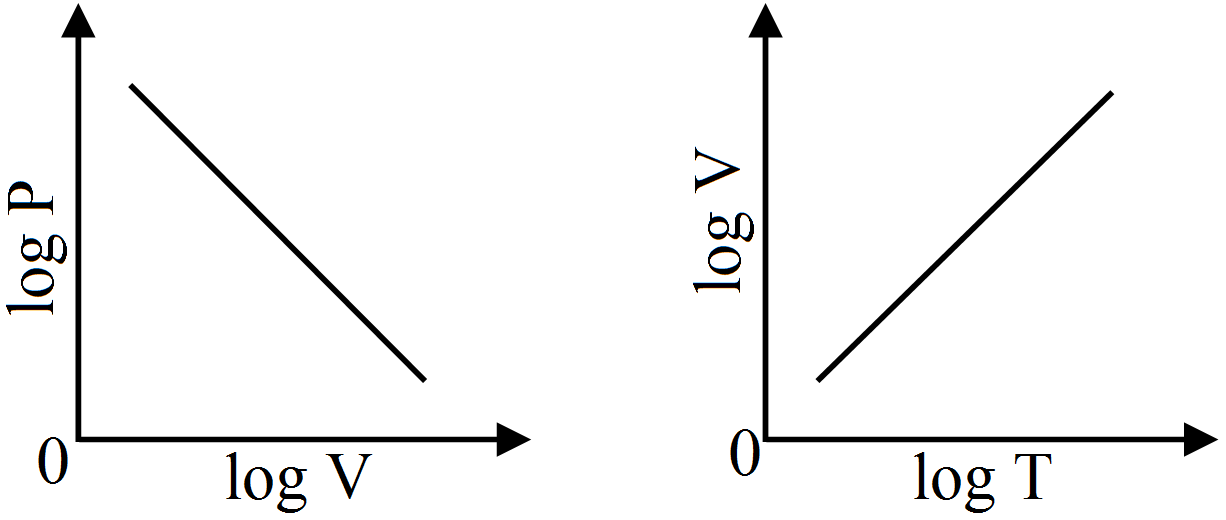
For an ideal gas, how does the plot of $\log\text{p vs}\log\text{V}$ differ from that of $\text{V vs}\log\text{T}$? Explain.

Answer


The plot of $\log \text{p vs}\log \text{V}$ is based on Boyle's law, whereas that of $\text{V vs} \log \text{T}$ is based on Charle's law.
Boyle's law
pV = k
Charle's law
$\frac{\text{V}}{\text{T}}=\text{k}$
$\begin{matrix}\log \text{p}+\log\text{V}=\log\text{k} & \log \text{V}-\log\text{T}=\log\text{k} \\\log\text{p}=-\log\text{V}+\log\text{k} & \log\text{V}=\log\text{T}+\log\text{k} \end{matrix}$
Both equations (i) and (ii) are comparable to y = mx + C and therefore, they represent straight lines. Their plots are as under.

Need a full question paper?

Generate a complete, print-ready paper with questions like this in minutes — across 16+ boards, with answer keys.
Start Generating Free

Similar questions

Draw Newman and Sawhorse projections for the eclipsed and staggered conformations of ethane. Which of these conformations is more stable and why?
Explain why the following system are not aromatic?
A 1.25 g sample of octane $\left(\mathrm{C}_8 \mathrm{H}_{18}\right)$ is burnt in excess of oxygen in a bomb calorimeter. The temperature of calorimeter rises from 294.05 to 300.78 K . If heat capacity of the calorimeter is 8.93 kJ K . Find heat transferred to calorimeter.
$\text{Fe}_2\text{O}_3+3\text{CO}\text{(g)}\xrightarrow{ \ \ \ \ \ \ \ }2\text{Fe}\text{(s)}+3\text{CO}_2\text{(g)}$
Compare the $\text{H}-\text{N}-\text{H}$ bond angle in the following molecules and ions:
$\text{NH}_3,\text{NH}_4^+,\text{NH}^-_2$
Arrange the following in decreasing order of stability:
Use the following data to calculate the $\text{K}_{\text{sp}}$ value for Agl(s)$\text{H}_{2}\text{(g)} + \text{Cl}_{2} \text{(g)} \rightleftharpoons\text{2HCl(g)}$
$\Delta\text{H}^{\circ} = -92\text{kJ}, \ \Delta\text{S}^{\circ} = -95\text{JK}^{-1}$
The Vividh Bharati station of All India Radio, Delhi, broadcasts on a frequency of 1,368kHz (kilohertz). Calculate the wavelength of the electromagnetic radiation emitted by transmitter. Which part of the electromagnetic spectrum does it belong to?
What do you meant by hyperconjugation? Explain it and explain hyperconjugation in ethyl carbocation.
${ }_{31} \mathrm{Ga}$ has slightly higher ionisation enthalpy than ${ }_{13} \mathrm{Al}$ although it occupies lower position in the group?