MCQ
For an ideal junction diode,
  • A
    forward bias resistance is infinity.
  • B
    forward bias resistance is zero.
  • C
    reverse bias resistance is infinity.
  • both (B) and (C).

Answer

Correct option: D.
both (B) and (C).
both (B) and (C).

Need a full question paper?

Generate a complete, print-ready paper with questions like this in minutes — across 16+ boards, with answer keys.
Start Generating Free

Similar questions

An explosion breaks a rock into three parts in a horizontal plane. Two of them go off at right angles to each other. The first part of mass 1 kg moves with a speed of $12 m s ^{-1}$ and the second part of mass 2 kg moves with $8 m s ^{-1}$ speed. If the third part flies off with $4 m s ^{-1}$ speed, then its mass is
A lift is tied with thick iron ropes having mass $M$. The maximum acceleration of the lift is a $m/s^2$ and maximum safe stress is $S M/s^2$. The minimum diameter of the rope is
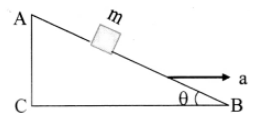
A block of mass m is placed on a smooth inclined wedge ABC of inclination θ as shown in the figure. The wedge is given an acceleration ‘a’ towards the right. The relation between a and θ for the block to remain stationary on the wedge isImage 
A projectile is thrown with an initial velocity of 50 m/s. The maximum horizontal distance which this projectile can travel is
A sphere, a cube and a thin circular plate all made of same material and having the same mass are heated to same temperature of $200^{\circ} C$. When these are left in a room
The waves used by artificial satellites for communication purposes are
A calorie is a unit of heat energy and its value is $18 J$, where $1 J =1 kg m ^2 s ^{-2}$. Suppose we use a new system of units in which unit of mass equals $x kg$, the unit of length equals $y m$ and the unit of the time is $z sec$. Then the value of a calorie in the new system of units is
A body is projected vertically upwards with a velocity of $10 ms^{-1}$ and another body is projected simultaneously from the same point with a velocity of $20 ms^{-1}$ at an angle of $\frac{\pi}{6}$ with the horizontal. The distance between the bodies after one second from the time projection is (Acceleration due to gravity $\left.10 ms^{-2}\right)$
Two stones are projected with the same speed but making different angles with the horizontal. Their ranges are equal. If the angle of projection of one is $\frac{\pi^c}{3}$and its maximum height is H, then the maximum height of the other is
Two isolated point poles of strength $30 A-m$ and $60 A-m$ are placed at a distance of $0.3 m.$ The force of repulsion between them is