MCQ
For an ideal liquid
  • A
    The bulk modulus is infinite.
  • B
    The shear modulus is zero.
  • C
    The shear modulus is infinite.
  • Both $A$ and $B$

Answer

Correct option: D.
Both $A$ and $B$
An ideal liquid is not compressible.
Bulk modulus $(\text{K})=\frac{-\text{p(V)}}{\Delta\text{V}} (\because\Delta\text{V=0})$
$\because\Delta\text{V=0}$ for ideal liquid.
$\therefore\text{K=}\infty$ for ideal liquid.
As there is no net tangential force on liquid $(S.T.$ is all around on a particle$)$ so shearing strain $\Delta\theta=0$ and $F=0.$
$\eta=\frac{\text{F/A}}{\Delta\theta}=\frac{0}{0}$ indeterminant value.
Hence, verifies option $(a)$ and $(b)$ and rejects option $(c).$

Need a full question paper?

Generate a complete, print-ready paper with questions like this in minutes — across 16+ boards, with answer keys.
Start Generating Free

Similar questions

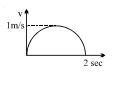
Velocity-time graph for a car is semicircle as shown here. Which of the following is correct :
A person of mass $M$ is, sitting on a swing of length $L$ and swinging with an angular amplitude $\theta_0$. If the person stands up when the swing passes through its lowest point, the work done by him, assuming that his centre of mass moves by a distance $l\, ( l < < L)$, is close to
In an experiment to determine the period of a simple pendulum of length $1\, m$, it is attached to different spherical bobs of radii $r_1$ and $r_2$ . The two spherical bobs have uniform mass distribution. If the relative difference in the periods, is found to be $5\times10^{-4}\, s$, the difference in radii, $\left| {{r_1} - {r_2}} \right|$ is best given by .... $cm$
The $x-$component of the resultant of several vectors:
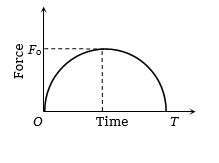
A particle of mass $m$, initially at rest, is acted upon by a variable force $F$ for a brief interval of time $T$. It begins to move with a velocity $u$ after the force stops acting. $F$ is shown in the graph as a function of time. The curve is a semicircle.
Young's modulus of a material has the same unit as:
A charged particle moves in a gravity$-$free space without change in velocity. Which of the following is are possible:
  1. $\text{E}=0,\ \text{B}=0$
  2. $\text{E}=0,\ \text{B}\not=0$
  3. $\text{E}\not=0,\ \text{B}=0$
  4. $\text{E}\not=0,\ \text{B}\not=0$
A particle moves in the $x-y$ plane under the action of a force $\,\vec F$ such that the value of its linear momentum $(\,\vec P)$ at anytime $t$ is $P_x = 2cost$ , $P_y = 2sint$ . The angle between $\,\vec F$ and $\,\vec P$ at a given time $t$ , will be 
The velocity of a particle is zero at $t = 0.$
  1. The acceleration at $t = 0$ must be zero.
  2. The acceleration at $t = 0$ may be zero.
  3. If the acceleration is zero from $t = 0$ to $t = 10s,$ the speed is also zero in this interval.
  4. If the speed is zero from $t = 0$ to $t = 10s$ the acceleration is also zero in this interval.
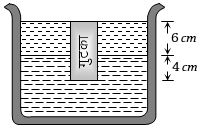
A cubical block of wood $10 \,cm$ on a side floats at the interface between oil and water with its lower surface horizontal and $4\, cm$ below the interface. The density of oil is $0.6gc{m^{ - 3}}$. The mass of block is ...... $gm$