MCQ
For an ideal solution, the correct option is 
  • A
    $\Delta_{\text {mix }} \mathrm{S}=0$ at constant $\mathrm{T}$ and $\mathrm{P}$
  • B
    $\Delta_{\text {mix }} \mathrm{V}\ne 0$ at constant $\mathrm{T}$ and $\mathrm{P}$
  • $\Delta_{\text {mix }} \mathrm{H}=0$ at constant $\mathrm{T}$ and $\mathrm{P}$
  • D
    $\Delta_{\text {mix }} \mathrm{G}=0$ at constant $\mathrm{T}$ and $\mathrm{P}$

Answer

Correct option: C.
$\Delta_{\text {mix }} \mathrm{H}=0$ at constant $\mathrm{T}$ and $\mathrm{P}$
c
For ideal solution $\Delta \mathrm{H}_{\mathrm{max}}-0$

Need a full question paper?

Generate a complete, print-ready paper with questions like this in minutes — across 16+ boards, with answer keys.

Start Generating Free

Similar questions

The acid having the highest $p{K_a}$ value among the following is
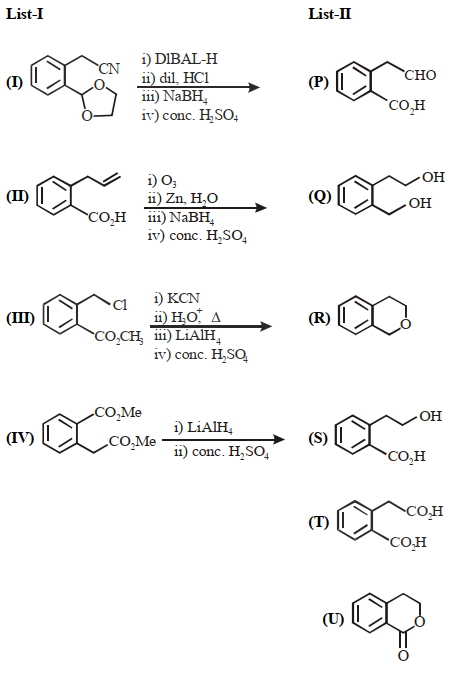
Answer the following by appropriately matching the lists based on the information given in the paragraph $List-I$ includess starting materials and reagents of selected chemical reactions. $List-II$ gives structures of compounds that may be formed as intermediate products and/or final products from the reactions of $List-I$

($1$) Which of the following options has correct combination considering $List-I$ and $List-II$?

$(1) (III), (S), (R)$ $(2) (IV), (Q), (R)$ $(3) (III), (T), (U)$ $(4) (IV), (Q), (U)$

($2$) Which of the following options has correct combination considering $List-I$ and $List-II$?

$(1) (I), (Q), (T), (U)$ $(2) (II), (P), (S), (U)$ $(3) (II), (P), (S), (T)$ $(4) (I), (S), (Q), (R)$

Give the answer quetion ($1$) and ($2$)

The reaction of white phosphorous with aqueous $NaOH$ gives phosphine along with another phosphorus containing compound. The reaction type; the oxidation states of phosphorous in phosphine and the other product are respectively
The number of atomic orbitals from the following having $5$ radial nodes is $.......$. $7 s , 7 p , 6 s , 8 p , 8 d$
Which is heaviest among the following
Shape of ${O_2}{F_2}$ is similar to that of
Which of the following pairs is/are correctly matched?
  Reaction Product
$I$ $RX + AgCN$ $RNC$
$II$ $RX + KCN$ $RCN$
$III$ $RX + KNO_2$ (image)
$IV$ $RX + AgNO_2$ $R-O-N = O$

If the $Z{n^{2 + }}/Zn$ electrode is diluted to $100$ times then the change in e.m.f.
Which buffer is present in human blood :-
In $3 d$ series, the metal having the highest $M ^{2+} / M$ standard electrode potential is .... .