MCQ
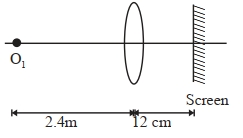
For an object placed at a distance $2.4\,m$ from a lens, a sharp focused image is observed on a screen placed at a distance $12\,cm$ from the lens. A glass plate of refractive index $1.5$ and thickness $1\,cm$ is introduced between lens and screen such that the glass plate plane faces parallel to the screen. By what distance should the object be shifted so that a sharp focused image is observed again on the screen $\dots\,m$
  • A
    $0.8$
  • $3.2$
  • C
    $1.2$
  • D
    $5.6$

Answer

Correct option: B.
$3.2$
b
Applying lens formula

$\frac{1}{0.12}+\frac{1}{2.4}=\frac{1}{f} \Rightarrow \frac{1}{f}=\frac{210}{24}$

Upon putting the glass slab, shift of image is

$\Delta x = t \left(1-\frac{1}{\mu}\right)=\frac{1}{3}\,cm$

Now $v =12-\frac{1}{3}=\frac{35}{3}\,cm$

Again apply lens formula

$\frac{1}{0.12}+\frac{1}{ u }=\frac{1}{ f }=\frac{210}{24}$

Solving $u =-5.6\,m$

Thus shift of object is

$5.6-2.4=3.2\,m$

Need a full question paper?

Generate a complete, print-ready paper with questions like this in minutes — across 16+ boards, with answer keys.

Start Generating Free

Similar questions

Convergence of concave mirror can be decreased by dipping in
A condenser having a capacity $2.0$ micro farad is charged to $200\;volts$ and then the plates of the capacitor are connected to a resistance wire. The heat produced in joules will be
The focal length of the objective lens of a compound microscope is
Let $P\left( r \right) = \frac{Q}{{\pi {R^4}}}r$ be the charge density distribution for a solid sphere of radius $R$ and total charge $Q$. For a point $P$ inside the sphere at distance $r_1$ from the centre of the sphere, the magnitude of electric field is
For an isotropic medium B, m, H and M are related as (where B, $\mu_0, H$ and M have their usual meaning in the context of magnetic material
Light waves producing interference have their amplitudes in the ratio $3 : 2$. The intensity ratio of maximum and minimum of interference fringes is
In Young’s double slit experiment, the wavelength of the light used is doubled and distance between two slits is half of initial distance, the resultant fringe width becomes........$  times$
In an experiment to measure focal length $(f)$ of convex lens, the least counts of the measuring scales for the position of object $(u)$ and for the position of image $(v)$ are $\Delta u$ and $\Delta v$, respectively. The error in the measurement of the focal length of the convex lens will be :
An $\alpha$-particle (mass $4 amu$ ) and a singly charged sulfur ion (mass $32 amu$ ) are initially at rest. They are accelerated through a potential $V$ and then allowed to pass into a region of uniform magnetic field which is normal to the velocities of the particles. Within this region, the $\alpha$-particle and the sulfur ion move in circular orbits of radii $r_\alpha$ and $r_5$, respectively. The ratio $\left(r_s / r_\alpha\right)$ is. . . . .$(4)$
Match the nuclear processes given in column $I$ with the appropriate option$(s)$ in column $II$
column $I$ column $II$
$(A.)$Nuclear fusion $(P.)$ Absorption of thermal neutrons by ${ }_{92}^{213} U$
$(B.)$Fission in a nuclear reactor $(Q.)$ ${ }_{27}^{60} Co$ nucleus
$(C.)$ $\beta$-decay $(R.)$ Energy production in stars via hydrogen conversion to helium
$(D.)$ $\gamma$-ray emission $(S.)$ Heavy water
  $(T.)$ Neutrino emission