MCQ
For an object projected from ground with speed $u$ horizontal range is two times the maximum height attained by it. The horizontal range of object is ..........
  • A
    $\frac{2 u^2}{3 g}$
  • B
    $\frac{3 u^2}{4 g}$
  • C
    $\frac{3 u^2}{2 g}$
  • $\frac{4 u^2}{5 g}$

Answer

Correct option: D.
$\frac{4 u^2}{5 g}$
d
(d)

$R=24$ also,$\frac{H}{R}=\frac{1}{4} \tan \theta$

$\frac{H}{R}=\frac{1}{2} \Rightarrow \frac{1}{2}=\frac{1}{4} \tan \theta$

$\tan \theta=2=\frac{P}{B}$

$R=\frac{2 u^2 \sin \theta \cos \theta}{g}$

$R=\frac{2 u^2}{g} \cdot \frac{2}{\sqrt{5}} \times \frac{1}{\sqrt{5}}$

$R=\frac{4 u^2}{5 g}$

Need a full question paper?

Generate a complete, print-ready paper with questions like this in minutes — across 16+ boards, with answer keys.

Start Generating Free

Similar questions

The flat face of a plano-convex lens of focal length $10 cm$ is silvered. A point source placed $30 \,cm$ in front of the curved surface will produce a
One nanometre is equal to
Three simple harmonic motions of equal amplitudes $A$ and equal time periods in the same direction combine. The phase of the second motion is $60^o$ ahead of the first and the phase of the third motion is $60^o$ ahead of the second. Find the amplitude of the resultant motion
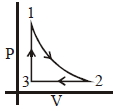
Which of the following is an equivalent cyclic process corresponding to the thermodynamic cyclic given in the figure? where, $1 \rightarrow 2$ is adiabatic.

(Graphs are schematic and are not to scale)

A person observes two moving trains, '$A$' reaching the station and '$B$' leaving the station with equal speed of $30\,m / s$. If both trains emit sounds with frequency $300\,Hz$, (Speed of sound : $330\,m / s$ ) approximate difference of frequencies heard by the person will be $..........Hz$
If magnitude of average speed and average velocity over a time interval are same, then
The equivalent resistance of resistors connected in series is always
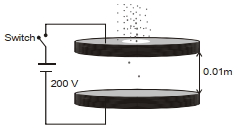
Two large circular discs separated by a distance of $0.01 m$ are connected to a battery via a switch as shown in the figure. Charged oil drops of density $900 kg m ^{-3}$ are released through a tiny hole at the center of the top disc. Once some oil drops achieve terminal velocity, the switch is closed to apply a voltage of $200 V$ across the discs. As a result, an oil drop of radius $8 \times 10^{-7} m$ stops moving vertically and floats between the discs. The number of electrons present in this oil drop is (neglect the buoyancy force, take acceleration due to gravity $=10 ms ^{-2}$ and charge on an electron ($e$) $=1.6 \times 10^{-19} C$ )
$A$ cylinder of radius $R$ made of a material of thermal conductivity ${K_1}$ is surrounded by a cylindrical shell of inner radius $R$ and outer radius $2R$ made of material of thermal conductivity ${K_2}$. The two ends of the combined system are maintained at two different temperatures. There is no loss of heat across the cylindrical surface and the system is in steady state. The effective thermal conductivity of the system is
A plane electromagnetic wave propagating in $\mathrm{x}$-direction is described by

$\mathrm{E}_{\mathrm{y}}=\left(200\  \mathrm{Vm}^{-1}\right) \sin \left[1.5 \times 10^7 \mathrm{t}-0.05\  \mathrm{x}\right] \text {; }$

The intensity of the wave is :(Use $\epsilon_0=8.85 \times 10^{-12} \mathrm{C}^2 \mathrm{~N}^{-1} \mathrm{~m}^{-2}$ )