MCQ
For any $2 \times 2$ matrix $ A$, if $A(adj.\,\,A)$= $\left[ {\begin{array}{*{20}{c}}{10}&0\\0&{10}\end{array}} \right]$, then $|A|\, = $
  • A
    $0$
  • $10$
  • C
    $20$
  • D
    $100$

Answer

Correct option: B.
$10$
b
(b) $A(adj\,.\,A) = |A|\,I \Rightarrow \,\left| {\,\begin{array}{*{20}{c}}{10}&0\\0&{10}\end{array}\,} \right| = 10\,.\,\left| {\,\begin{array}{*{20}{c}}1&0\\0&1\end{array}\,} \right|$.

Need a full question paper?

Generate a complete, print-ready paper with questions like this in minutes — across 16+ boards, with answer keys.

Start Generating Free

Similar questions

$\frac{{2\sin \theta \,\tan \theta (1 - \tan \theta ) + 2\sin \theta {{\sec }^2}\theta }}{{{{(1 + \tan \theta )}^2}}} = $
Let $R ^3$ denote the three-dimensional space. Take two points $P=(1,2,3)$ and $Q=(4,2,7)$. Let $\operatorname{dist}(X, Y)$ denote the distance between two points $X$ and $Y$ in $R ^3$. Let

$S=\left\{X \in R ^3:(\operatorname{dist}(X, P))^2-(\operatorname{dist}(X, Q))^2=50\right\} \text { and }$

$T=\left\{Y \in R ^3:(\operatorname{dist}(Y, Q))^2-(\operatorname{dist}(Y, P))^2=50\right\}.$

Then which of the following statements is (are) $TRUE$?

$(A)$ There is a triangle whose area is $1$ and all of whose vertices are from $S$.

$(B)$ There are two distinct points $L$ and $M$ in $T$ such that each point on the line segment $L M$ is also in $T$.

$(C)$ There are infinitely many rectangles of perimeter $48$ , two of whose vertices are from $S$ and the other two vertices are from $I$.

$(D)$ There is a square of perimeter $48$ , two of whose vertices are from $S$ and the other two vertices are from $T$.
A rod of length eight units moves such that its ends $A$ and $B$ always lie on the lines $x-y+2=0$ and $y+2=0$, respectively. If the locus of the point $P$, that divides the rod AB internally in the ratio $2: 1$ is $9\left(x^2+\alpha y^2+\beta x y+\gamma x+28 y\right)-76=0$, then $\alpha-\beta-\gamma$ is equal to :
Let the median and the mean deviation about the median of $7$ observation $170,125,230,190,210 a, b$ be $170$ and $\frac{205}{7}$ respectively. Then the mean deviation about the mean of these $7$ observations is :
$\left| {\,\begin{array}{*{20}{c}}x&4&{y + z}\\y&4&{z + x}\\z&4&{x + y}\end{array}\,} \right| = $
The multiplicative inverse of matrix $\left[ {\begin{array}{*{20}{c}}2&1\\7&4\end{array}} \right]$is
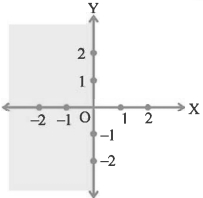
The inequality to represent the coloured region in figure is....
The points $(at_1^2,2a{t_1}),(at_2^2,2a{t_2})$and $(a,0)$will be collinear, if
The locus of the middle point of the intercept of the tangents drawn from an external point to the ellipse ${x^2} + 2{y^2} = 2$ between the co-ordinates axes, is
Let $P(x)$ be a polynomial with real coefficients such that $P\left(\sin ^2 x\right)=P\left(\cos ^2 x\right)$ for all $x \in[0, \pi / 2)$. Consider the following statements:

$I.$ $P(x)$ is an even function.

$II.$ $P(x)$ can be expressed as a polynomial in $(2 x-1)^2$

$III.$ $P(x)$ is a polynomial of even degree.

Then,