MCQ
For any charge configuration, equipotential surface through a point is _____ to electric field at that point.
  • A
    Perpendicular.
  • B
    Normal.
  • C
    Parallel.
  • D
    Both a and b.

Answer

  1. Both a and b.

Need a full question paper?

Generate a complete, print-ready paper with questions like this in minutes — across 16+ boards, with answer keys.

Start Generating Free

Similar questions

If a number of sine waves with modulation indices n1, n2, n3 ........ modulate a carrier wave, then total modulation index (n) of the wave is

(a) n1 + n2 .... + 2(n1 + n2.....)

(b)  

(c)  

(d) None of these

A conducting ring of radius R and one turn is formed from a conducting wire of length L and on passing current I the obtained magnetic dipole moment is $m$. If this wire is then converted to a ring of two turns and on passing electric current I, the new magnetic dipole moment obtained is _________.
In white light interference, nearest to the central (bright) fringe, will have which of the following colour:
Which of the following devices can be used as a square law device for modulation.

Consider the following two statements

A. Energy spectrum of a-particles emitted in radioactive decay is discrete

B. Energy spectrum of b-particles emitted in radioactive decay is continuous

(a) Only A is correct

(b) Only B is correct

(c) A is correct but B is wrong

(d) Both A and B are correct

Which logic gate is represented by following diagram
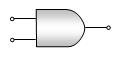
(a) AND

(b) OR

(c) NOR

(d) XOR

An electric heating element in vacuum is surrounded by a cavity at constant temperature of 227ºC; it consumes 60W of power to maintain a temperature of 727ºC. What is the power consumed by the element to maintain a temperature of 1227º C?
An electric dipole consisting of charges +q and -q separated by a distance L is in stable equilibrium in a uniform electric field $\vec{\text{E}}.$ The electrostatic potential energy of the dipole is:
The tangent at any point of  field line gives the direction of:
A particle moves in a circular path with a uniform speed. Its motion is:
  1. Periodic.
  2. Oscillatory.
  3. Simple harmonic.
  4. Angular simple harmonic.

