Question
For any solvent, the molal gradient constants value is certain. Why?
Answer

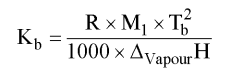
The molal elevation constant is calculated from the following formula :
Image
All the value present in this formula, R (gas constant or solution constant), $M _1$ (Molar mass of solvent, $T _{ b }$ (boiling point of solvent) and $\Delta_{\text {vaporisation }} H$ (enthalpy of vaporisation) of solvent are fixed, hence molar elevation constant $\left( K _{ b }\right)$ is also fixed.

Need a full question paper?

Generate a complete, print-ready paper with questions like this in minutes — across 16+ boards, with answer keys.

Start Generating Free

Similar questions

Note: In the following questions a statement of assertion followed by a statement of reason is given. Choose the correct answer out of the following choices.
Assertion: Coagulation power of $Al^{3+}$ is more than $Na^+.$
Reason: Greater the valency of the flocculating ion added, greater is its power to cause precipitation $($Hardy Schulze rule$).$
Write the mechanism of the reaction of HI with methoxymethane.
Explain the preparation of carboxylic acid from acyl halides and anhydrides with necessary equations.
Calculate the freezing point of a solution containing $60\ g$ of glucose $($Molar mass $=180 \mathrm{~g} \mathrm{~mol}^{-1}$ $)$ in $250\ g$ of water. $\left(K_f\right.$ of water $\left.=1.86 \mathrm{~K} \mathrm{~kg} \mathrm{~mol}^{-1}\right)$
What happens when the vapours of a primary, secondary and tertiary alcohol are passed over heated copper at 573 K temperature? Explain with chemical equation.
Write the mechanism of acid dehydration of ethanol to yield ethene.
What happens when:
  1. $SO_2$ gas is passed through an aqueous solution $Fe^{3+}$ salt?
  2. $XeF_4$ reacts with $SbF_5?$
Consider the standard electrode potential values $\left(\frac{M^{2+}}{M}\right)$ of the elements of the first transition series.
$Ti$ $V$ $Cr$ $Mn$ $Fe$ $Co$ $Ni$ $Cu$ $Zn$
$-1.63$ $-1.18$ $-0.90$ $-1.18$ $-0.44$ $-0.28$ $-0.25$ $+0.34$ $-0.76$
$i. E^\circ $ value for copper is positive.
$ii. E^\circ $ value of $Mn$ is more negative as expected from the trend.
$iii. Cr^{3+}$ is a stronger reducing agent than $Fe^{2+}.$
Give examples of the common names of carboxylic acid which are derived from Latin or Greek names of their natural sources.
What makes a glass different from a solid such as quartz? Under what conditions could quartz be converted into glass?