Question
For any square matrix $A, A A^T$ is a

Answer

(b) : We have, $\left(A A^T\right)^T=\left(A^T\right)^T A^T=A A^T$
$\therefore \quad A A^T$ is a symmetric matrix.

Need a full question paper?

Generate a complete, print-ready paper with questions like this in minutes — across 16+ boards, with answer keys.
Start Generating Free

Similar questions

Find the principal values of: $\cot ^{-1}(-\sqrt{3})$
The maximum value of Z = 4x + 3y subjected to the constraints 3x + 2y ≥ 160, 5x + 2y ≥ 200, x + 2y ≥ 80, x, y ≥ 0 is:
  1. 320
  2. 300
  3. 230
  4. none of these
A box contains 3 orange balls, 3 green balls and 2 blue balls. Three balls are drawn at random from the box without replacement. The probability of drawing 2 green balls and one blue ball is
A constant function f : A → B will be one-one if:
  1. n(A) = n(B)
  2. n(A) = 1
  3. n(B) = 1
  4. n(A) < n(B)
If A(6, 3, 2), B(5, 1, 4), C(3, −4, 7), D(0, 2, 5) are four points, then projection of CD on AB is:
  1. $-\frac{13}{7}$
  2. $-\frac{13}{7}$
  3. $-\frac{3}{13}$
  4. $-\frac{7}{13}$
Area of the region between the curves $\text{x}^2+\text{y}^2=\pi,\text{y}=\sin\text{x}$ and y-axis in first quadrant is:
  1. $\frac{\pi^3-8}{4\text{ sq.}\text{ units}}$
  2. $\frac{\pi^3-4}{4\text{ sq.}\text{ units}}$
  3. $\frac{\pi^3-8}{4\text{ sq.}\text{ units}}$
  4. $\frac{\pi^3-4}{4\text{ sq.}\text{ units}}$
The region represented by the inequalities $\text{x}\geq6,\text{y}\geq2,2\text{x}+\text{y}\leq0,\text{x}\geq0,\text{y}\geq{0}$ is:
  1. Unbounded
  2. A polygon
  3. Exterior of a triangle
  4. None of these
Let A = N × N and × be the binary operation on A defined by (a, b) × (c, d) = (a + c, b + d). Then × is:
  1. Commutative.
  2. Associative.
  3. Both (a) and (b).
  4. None of these.l
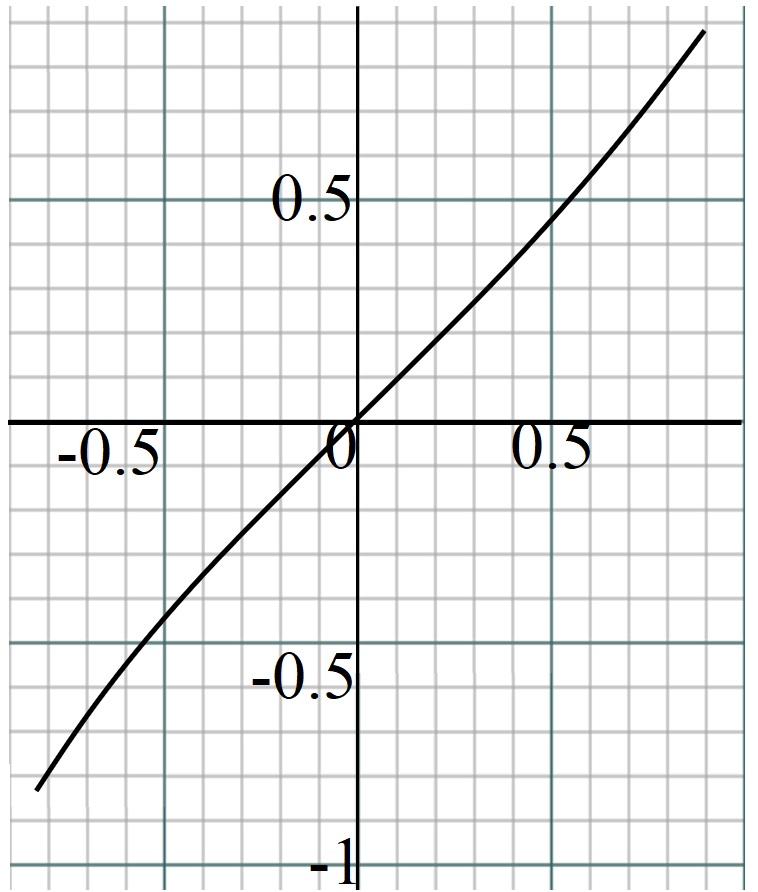
The given graph is for which equation?
  1. $\text{y}= \sin\text{x}$
  2. $\text{y} = \sin-1\text{x}$
  3. $\text{y} = \text{cosec }\text{x}$
  4. $\text{y} = \sec\text{x}$
$\int\limits^\pi_0\frac{1}{\text{a}+\text{b}\cos\text{x}}\text{ dx}=$
  1. $\frac{\pi}{\sqrt{\text{a}^2-\text{b}^2}}$
  2. $\frac{\pi}{\text{ab}}$
  3. $\frac{\pi}{\text{a}^2-\text{b}^2}$
  4. $({\text{a}+\text{b}})\pi$