MCQ
For any square matrix $A$ with real number entries, consider the following statements.
Assertion (A) : $A+A^{\prime}$ is a symmetric matrix.
Reason (R): $A-A^{\prime}$ is a skew-symmetric matrix.
  • A
    Both (A) and (R) are true and (R) is the correct explanation of (A).
  • Both (A) and (R) are true but (R) is not the correct explanation of (A).
  • C
    (A) is true but (R) is false.
  • D
    (A) is false but (R) is true.

Answer

Correct option: B.
Both (A) and (R) are true but (R) is not the correct explanation of (A).
(b) : Let $B=A+A^{\prime}$, then
$
B^{\prime}=\left(A+A^{\prime}\right)^{\prime}=A^{\prime}+\left(A^{\prime}\right)^{\prime}=A^{\prime}+A=A+A^{\prime}=B
$
Therefore, $B=A+A^{\prime}$ is a symmetric matrix.
Now, let $C=A-A^{\prime}$
$
C^{\prime}=\left(A-A^{\prime}\right)^{\prime}=A^{\prime}-\left(A^{\prime}\right)^{\prime}=A^{\prime}-A=-\left(A-A^{\prime}\right)=-C
$
Therefore, $C=A-A^{\prime}$ is a skew-symmetric matrix.

Need a full question paper?

Generate a complete, print-ready paper with questions like this in minutes — across 16+ boards, with answer keys.

Start Generating Free

Similar questions

Directions: In the following questions, a statement of assertion $(A)$ is followed by a statement of reason $(R).$ Mark the correct choice as:
Assertion: Consider the function f : $R \rightarrow R$ defined by $f(x) = x^3.$ Then f is one $-$ one.
Reason: Every polynomial function is one $-$ one.
Directions : In the following questions, a statement of assertion $(A)$ is followed by a statement of reason $(R).$ Mark the correct choice as :
Assertion : The function $f : R \rightarrow R, \text{f}(\text{x})=\mid\text{x}\ \mid$ is not one $-$ one.
Reason : The function $\text{f}(\text{x})=\mid\text{x}\ \mid$ is not onto.
Directions : In the following questions, the Assertions $(A)$ and Reason $(s)\ (R)$ have been put forward. Read both the statements carefully and choose the correct alternative from the following:
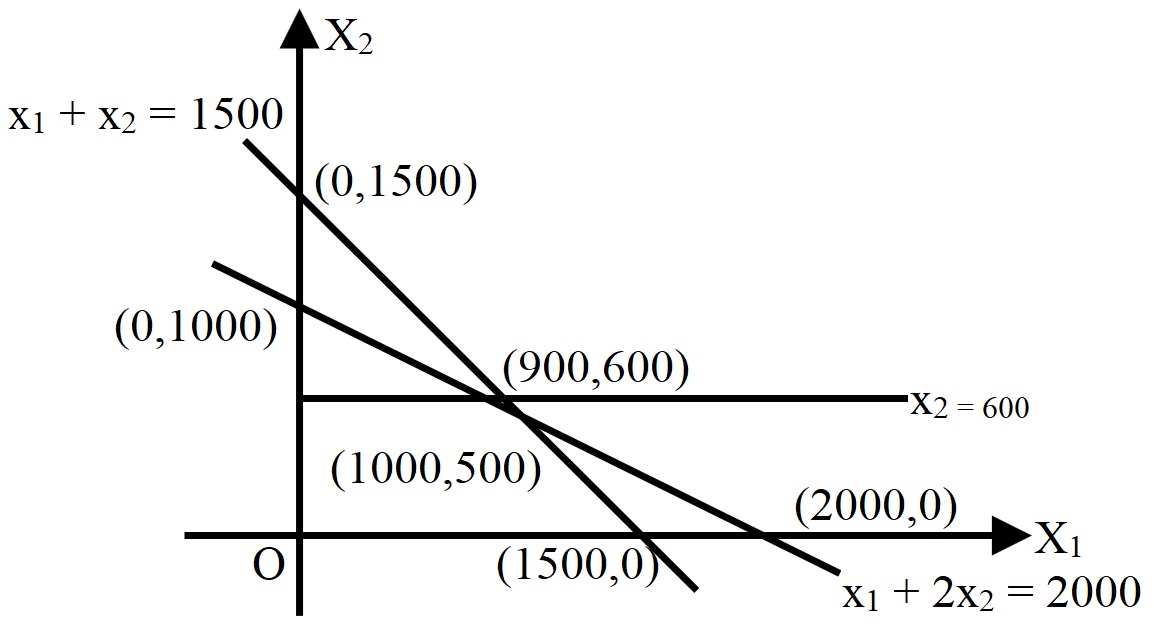
Assertion $(A) :$ For the constraints of a $\text{LPP}$ problem given by $\text{x}_1+2\text{x}_2\leq2000,\text{x}_1+\text{x}_2\leq1500,\text{x}^2\leq600$ and $\text{x}_1,\text{x}_2\geq0$ the points $(1000, 0), (0, 500), (2, 0)$ lie in the positive bounded region, but point $(2000, 0)$ does not lie in the positive boundedregion.
Reason $(R) :$​​​​​​​
Directions : In the following questions, the Assertions $(A)$ and Reason $(s)\ (R) $ have been put forward. Read both the statements carefully and choose the correct alternative from the following :
Assertion $(A) :$ Slope of the curve given as $y^2 = x$ at $x = 1$ not defined.
Reason $(R) :$ Slope of the curve given as $y^2 = x$ at $x$ = is $\pm\frac{1}{2}.$
Directions: In the following questions, a statement of assertion $(A)$ is followed by a statement of reason $(R).$ Mark the correct choice as:
Assertion: If $A$ is a square matrix such that $A^2 = I, $ then $(I + A)^2 - 3A = I.$
Reason: $Al = IA = A,$ where $I$ is Idetity matrix.
Directions: In the following questions, a statement of assertion $(A)$ is followed by a statement of reason $(R).$ Mark the correct choice as:
Assertion: The solution of $\sin^{-1}(6\text{x})+\sin^{-1}(6\sqrt{3}\text{x})=\frac{-\pi}{2}$ is $\text{x}=\frac{1}{12}.$
Reason: $\cot^{-1}\text{x}$ is increasing function for $0\leq\text{x}\leq1.$
Directions: In the following questions, a statement of assertion $(A)$ is followed by a statement of reason $(R)$. Mark the correct choice as:
Assertion: If $\text{A}=\begin{pmatrix}1&\pi\\0&1\end{pmatrix},$ then $\text{A}^{100}=\begin{pmatrix}1&100\pi\\0&1\end{pmatrix}.$
Reason: If $B$ is matrix of order 2X2 and $B^2 = O$, then $(I + B)^n = I + nB$, for all $\text{n}\in\text{N}.$
Directions : In the following questions, a statement of assertion $(A)$ is followed by a statement of reason $(R).$ Mark the correct choice as :
Assertion : A function $f : A \rightarrow B,$ cannot be an onto function if $n(A) < n(B).$
Reason : A function $f$ is onto if every element of co $-$ domain has at least one pre $-$ image in the domain.
Assertion $(A)$ : If two positive numbers are such that sum is $16$ and sum of their cubes is minimum, then numbers are $8, 8.$
Reason $(R)$ : If f be a function defined on an interval $I$ and $c \in l$ and let $f$ be twice differentiable at $c,$ then $x = c$ is a point of local minima if $f\ '(c) = 0$ and $f\ "(c) > 0 $ and $f(c)$ is local minimum value of $f$.
Directions : In these questions, a statement of Assertion is followed by a statement of Reason is given.Choose the correct answer out of the following choices :
Assertion : The area bounded by the curves $\text{y}^2 = 4\text{a}^2(\text{x} - 1) $ and lines $\text{x}=1$ and $\text{y}=4 a$ is $\frac{8\text{a}}{3}\text{sq.units}$
Reason : The area enclosed between the parabola $\text{y}=\text{x}^2-\text{x}+2$ and the line $\text{y}=\text{x+2}$ is $\frac{4}{3}\text{ sq.units}$