MCQ
For continuous $X-$ rays produced wavelength is
  • Inversely proportional to the energy of the electrons hitting the target
  • B
    Inversely proportional to the intensity of the electron beam
  • C
    Proportional to intensity of the electron beam
  • D
    Proportional to target temperature

Answer

Correct option: A.
Inversely proportional to the energy of the electrons hitting the target
a
(a) ${\lambda _{\min }} = \frac{{hc}}{{eV}}$

Need a full question paper?

Generate a complete, print-ready paper with questions like this in minutes — across 16+ boards, with answer keys.

Start Generating Free

Similar questions

A body is rolling down an inclined plane. If kinetic energy of rotation is $40\%$ of  translational kinetic energy, then the body is a
In an interference experiment, the spacing between successive maxima or minima is

(Where the symbols have their usual meanings)

In Young's double slit experiment, angular width of fringes is $0.20^o$ for sodium light of wavelength $5890 Å$. If complete system is dipped in water, then angular width of fringes becomes....$^o$
Assertion : Energy is released in nuclear fission.

Reason : Total binding energy of the fission fragments is larger than the total binding energy of the parent nucleus

$100\ g$ of water is heated from $30^o C$ to $50^o C$. Ignoring the slight expansion of the water, the change in its internal energy is .......$kJ$ (specific heat of water is $4184\ J/kg/K$):
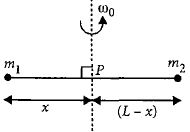
Point masses $m_1$ and $m_2$ are placed at the opposite ends of a rigid rod of length $L$, and negligible  mass. The rod is to be set rotating about an axis perpendicular to it. The position of point $P$ on this rod through which the axis should pass so that the work required to set the rod rotating with angular velocity $\omega_0$ is minimum, is given by
A point performs simple harmonic oscillation of period $T$ and the equation of motion is given by $x=Asin$$\left( {\omega t + \frac{\pi }{6}} \right)$. After the elapse of what fraction of the time period the velocity of the point will be equal to half of its maximum velocity? 
The acceleration of an electron in the first orbit of the hydrogen atom $(z\, = 1)$ is
Aboat having a speed of $5\,\, km/hr$. in still water, crosses a river of width $1\,\, km$ along the shortest possible path in $15 \,\,minutes$. The speed of the river in $Km/hr.$
A body is vibrating in simple harmonic motion with an amplitude of $0.06\, m$ and frequency of $15\, Hz$. The velocity and acceleration of body is