MCQ
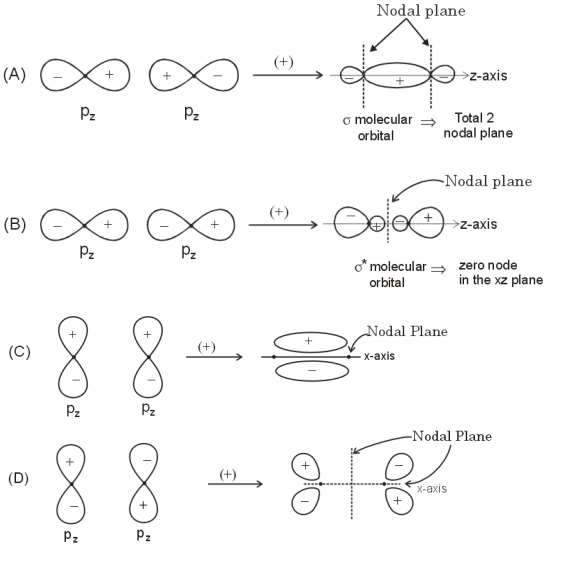
For diatomic molecules, the correct statement($s$) about the molecular orbitals formed by the overlap to two $2 p_z$ orbitals is(are)

$(A)$ $\sigma$ orbital has a total of two nodal planes.

$(B)$ $\sigma^*$ orbital has one node in the $x z$-plane containing the molecular axis.

$(C)$ $\pi$ orbital has one node in the plane which is perpendicular to the molecular axis and goes through the center of the molecule.

$(D)$ $\pi^*$ orbital has one node in the $x y$-plane containing the molecular axis.

  • A
    $A,B$
  • B
    $A,C$
  • C
    $A,B,C$
  • $A,D$

Answer

Correct option: D.
$A,D$
d
(image)

$\pi$-molecular orbital

Zero node in the plane which is perpendicular to the molecular axis and goes through the center of the molecule

$\pi^*$-molecular orbital

One node in xy plane containing the molecular axis

(image)

Need a full question paper?

Generate a complete, print-ready paper with questions like this in minutes — across 16+ boards, with answer keys.

Start Generating Free

Similar questions

The number of electrons which can be accommodated in an orbital is
Which of the following pairs has both members from the same group of the periodic table
Suggest the best reaction conditions for the synthesis shown below.
What is the packet of energy called
For the process
$A(g) + e^-\to  A^-(g);$                   $\Delta H = x$
and $A^-(g) \to A(g) + e^-$              $\Delta H = y$
Select correct alternate :
Which of the following compounds may not exist as enantiomers
The freezing point of aqueous solution which contains $5\%$ by mass urea, $1.0\%$ by mass $KCl$ and $10\%$ by mass of glucose is  ........ $K$. $\left( {{K_{{H_2}O}} = 1.86\,K\,molalit{y^{ - 1}}} \right)$
$A\xrightarrow[{{\text{1%  }}{{\text{H}}_2}{\text{S}}{{\text{O}}_4}}]{{{\text{20%  }}{{\text{H}}_2}{\text{S}}{{\text{O}}_4}}}B\xrightarrow{{{I_2} + NaOH}}{\text{C + }}{{\text{C}}_6}{{\text{H}}_5}{\text{COONa}}$ The reactant $'A'$ is
The molarity of the solution prepared by dissolving $6.3\, \mathrm{~g}$ of oxalic acid $\left(\mathrm{H}_{2} \mathrm{C}_{2} \mathrm{O}_{4} \cdot 2 \mathrm{H}_{2} \mathrm{O}\right)$ in $250\, \mathrm{~mL}$ of water in $\operatorname{mol} \mathrm{L}^{-1}$ is $\mathrm{x} \times 10^{-2} .$ The value of $\mathrm{x}$ is ..... . (Nearest integer)

[Atomic mass : $\mathrm{H}: 1.0, \mathrm{C}: 12.0, \mathrm{O}: 16.0]$

If the speed of electron in the Bohr's first orbit of hydrogen atom is $x$, the speed of the electron in the third Bohr's orbit is