MCQ
For given compounds 

The correct statement is
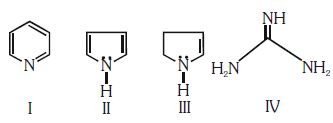
  • The most basic compound is $IV$
  • B
    The least basic compound is $I$
  • C
    The most basic compound is $III$
  • D
    The least basic compound is $IV$

Answer

Correct option: A.
The most basic compound is $IV$
a

Need a full question paper?

Generate a complete, print-ready paper with questions like this in minutes — across 16+ boards, with answer keys.

Start Generating Free

Similar questions

The reaction of white phosphorus with sodium hydroxide solution gives
In a catalytic conversion of ${N_2}$ to $N{H_3}$ by Haber's process, the rate of reaction was expressed as change in the concentration of ammonia per time is $40 \times {10^{ - 3}}\,mol\,litr{e^{ - 1}}{s^{ - 1}}$. If there are no side reaction, the rate of the reaction as expressed in terms of hydrogen is (in mol $litr{e^{ - 1}}{s^{ - 1}}$)
$\begin{array}{*{20}{c}}
  {\,\,\,\,\,\,C{H_3}\,C{H_3}\,} \\ 
  {|\,\,\,\,\,\,\,\,\,|\,} \\ 
  {C{H_3} - C - C - C{H_3}} \\ 
  {\,\,\,|\,\,\,\,\,\,\,\,|\,\,\,\,} \\ 
  {\,\,\,\,OH\,\,OH\,\,} 
\end{array}$ $\xrightarrow[\Delta ]{{{H^ \oplus }}}?$
In the reaction $A + B \to $ Products, if $B$ is taken in excess, then it is an example of
A chemist wants to determine the molecular geometry of the $[CoCl_4]^{2-}$ ion. Which of the following gives the best suggestion for a measurement and for the interpretation of that measurement ?
Least chemical activity is shown by
$\begin{gathered}
  \begin{array}{*{20}{c}}
  {O\,\,\,\,\,\,\,\,\,\,\,\,\,\,\,\,\,\,\,\,\,\,\,\,\,\,\,\,\,\,\,\,\,\,\,\,\,\,\,\,\,\,\,\,\,\,\,\,\,\,\,\,\,\,\,\,\,\,\,\,\,\,\,\,\,\,\,\,\,\,\,\,\,\,} \\ 
  {||\,\,\,\,\,\,\,\,\,\,\,\,\,\,\,\,\,\,\,\,\,\,\,\,\,\,\,\,\,\,\,\,\,\,\,\,\,\,\,\,\,\,\,\,\,\,\,\,\,\,\,\,\,\,\,\,\,\,\,\,\,\,\,\,\,\,\,\,\,\,\,\,\,\,} \\ 
  {C{H_3} - {\text{  }}C - {\text{ }}O - H\xrightarrow{{NaH{{\mathop {CO}\limits^{14} }_3}}}\mathop {(A)}\limits_{(gas)} \xrightarrow[{(ii){H_3}{O^ \oplus }}]{{(i)PhMgBr}}(B)} 
\end{array} \hfill \\
  \begin{array}{*{20}{c}}
  {O\,\,\,\,\,\,\,\,\,\,\,\,\,\,\,\,\,\,\,\,\,\,\,\,\,\,\,\,\,\,\,\,\,\,\,\,\,\,\,\,\,\,\,\,\,\,\,\,\,\,\,\,\,\,\,\,\,\,\,\,\,\,\,\,\,\,\,\,\,\,\,\,\,\,} \\ 
  {||\,\,\,\,\,\,\,\,\,\,\,\,\,\,\,\,\,\,\,\,\,\,\,\,\,\,\,\,\,\,\,\,\,\,\,\,\,\,\,\,\,\,\,\,\,\,\,\,\,\,\,\,\,\,\,\,\,\,\,\,\,\,\,\,\,\,\,\,\,\,\,\,\,\,} \\ 
  {C{H_3} - S - O - H\xrightarrow{{NaH\mathop {C{O_3}}\limits^{14} }}\mathop {(C)}\limits_{(gas)} \xrightarrow[{(ii){H_3}{O^ \oplus }}]{{(i)PhMgBr}}(D)} \\ 
  {||\,\,\,\,\,\,\,\,\,\,\,\,\,\,\,\,\,\,\,\,\,\,\,\,\,\,\,\,\,\,\,\,\,\,\,\,\,\,\,\,\,\,\,\,\,\,\,\,\,\,\,\,\,\,\,\,\,\,\,\,\,\,\,\,\,\,\,\,\,\,\,\,\,\,\,} \\ 
  {O\,\,\,\,\,\,\,\,\,\,\,\,\,\,\,\,\,\,\,\,\,\,\,\,\,\,\,\,\,\,\,\,\,\,\,\,\,\,\,\,\,\,\,\,\,\,\,\,\,\,\,\,\,\,\,\,\,\,\,\,\,\,\,\,\,\,\,\,\,\,\,\,\,\,\,\,} 
\end{array} \hfill \\ 
\end{gathered}$

Product $(B)$ and $(D) $ in the above reaction are

Elimination reaction of $2 -$Bromo-pentane to form pent$-2-$ene is:

$(a)$ $\beta$ $-$Elimination reaction

$(b)$ Follow Zaitsev rule

$(c)$ Dehydrohalogenation reaction

$(d)$ Dehydration reaction

For a reaction $\mathrm{A} \rightarrow \mathrm{B}$, enthalpy of reaction is $-4.2\, \mathrm{~kJ}$ mol $^{-1}$ and enthalpy of activation is $9.6\, \mathrm{~kJ} \mathrm{~mol}^{-1}$. The correct potential energy profile for the reaction is shown in option.
A hybrid orbital formed from $s-$ and $p-$orbital can contribute to: