MCQ
For harder X-rays:
- AThe wavelength is higher.
- BThe intensity is higher.
- CThe frequency is higher.
- DThe photon energy is higher.
Explanation:
Harder X-rays are the X-rays having low wavelengths. Since the frequency varies inversely with the wavelength, hard X-rays have high frequency.
Energy of a photon (E) is given by
$\text{E}=\frac{\text{hc}}{\lambda}$
Here,
h = Planck's constant
c = Speed of light
$\lambda$ = Wavelength of light.
Clearly, energy varies inversely with wavelength. Therefore, the energy of the photon will be higher for the hard X-ray.
Generate a complete, print-ready paper with questions like this in minutes — across 16+ boards, with answer keys.
Three resistances of magnitude 2, 3 and 5 ohm are connected in parallel to a battery of 10 volts and of negligible resistance. The potential difference across 3 Ω resistance will be
|
(a) 2 volts |
(b) 3 volts |
(c) 5 volts |
(d) 10 volts |
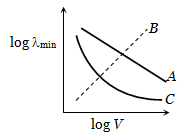
The dependence of the short wavelength limit  on the accelerating potential V is represented by the curve of figure
|
(a) A |
(b) B |
(c) C |
(d) None of these |
Beta rays emitted by a radioactive material are
|
(a) Electromagnetic radiation |
|
(b) The electrons orbiting around the nucleus |
|
(c) Charged particles emitted by nucleus |
|
(d) Neutral particles |
A metal conductor of length 1m rotates vertically about one of its ends at angular velocity 5 radians per second. If the horizontal component of earth's magnetic field is 0.2  , then the e.m.f. developed between the two ends of the conductor is
|
(a) 5mV |
(b) 5 |
(c) 50 mV |
(d) 50 μV |
The magnetic flux linked with a vector area  in a uniform magnetic field
  is
is
|
(a) |
(b) AB |
(c) |
(d) |
Assertion : Dielectric breakdown occurs under the influence of an intense light beam.
Reason : Electromagnetic radiations exert pressure.
|
(a) If both assertion and reason are true and the reason is the correct explanation of the assertion. |
|
(b) If both assertion and reason are true but reason is not the correct explanation of the assertion. |
|
(c) If assertion is true but reason is false. |
|
(d) If the assertion and reason both are false. |
Lenz's law gives
|
(a) The magnitude of the induced e.m.f. |
|
(b) The direction of the induced current |
|
(c) Both the magnitude and direction of the induced current |
|
(d) The magnitude of the induced current |


