MCQ
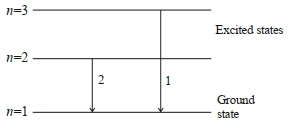
For hydrogen atom, $\lambda_1$ and $\lambda_2$ are the wavelengths corresponding to the transitions $1$ and $2$ respectively as shown in figure. The ratio of $\lambda_1$ and $\lambda_2$ is $\frac{x}{32}$. The value of $x$ is $..........$
  • $27$
  • B
    $26$
  • C
    $25$
  • D
    $24$

Answer

Correct option: A.
$27$
a
$\frac{1}{\lambda}= Rz ^2\left[\frac{1}{ n _1^2}-\frac{1}{ n _2^2}\right]$

$\frac{1}{\lambda_1}= Rz ^2\left[\frac{1}{1^2}-\frac{1}{3^2}\right]=\frac{8}{9} Rz ^2$

$\frac{1}{\lambda_2}= Rz ^2\left[\frac{1}{1^2}-\frac{1}{2^2}\right]=\frac{3}{4} Rz ^2$

$1 / 2 \Rightarrow \frac{\lambda_2}{\lambda_1}=\frac{8}{9} \times \frac{4}{3}=\frac{32}{27}$

$\frac{\lambda_1}{\lambda_2}=\frac{27}{32}$

Ans.$27$

Need a full question paper?

Generate a complete, print-ready paper with questions like this in minutes — across 16+ boards, with answer keys.

Start Generating Free

Similar questions

If a vector $\vec A$ is parallel to another vector $\vec B$ then the resultant of the vector $\vec A \times \vec B$ will be equal to
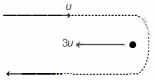
A spacecraft which is moving with a speed $u$ relative to the earth in the $x$-direction, enters the gravitational field of a much more massive planet which is moving with a speed $3 \,u$ in the negative $x$-direction. The spacecraft exits following the trajectory as shown below. The speed of the spacecraft with respect to the earth a long a time after it has escaped the planet's gravity is given by
A body takes $T$ minutes to cool from ${62^o}C$ to ${61^o}C$ when the surrounding temperature is ${30^o}C$. The time taken by the body to cool from ${70^o}$ to $({A_1}\,{\rm{and }}{A_{\rm{2}}})$ is
Consider a system of two identical particles. One of the particles is at rest and the other has an acceleration $\vec{f}$. The centre of mass has an acceleration
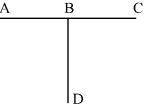
Three conducting rods of same material and cross-section are shown in figure. Temperatures of$ A, D$ and $C$ are maintained at $20^o C, 90^o C$ and $0^o C$. The ratio of lengths of $BD$ and $BC$ if there is no heat flow in $AB$ is:
Two discs of same thickness but of different radii are made of two different materials such that their masses are same. The densities of the materials are in the ratio $1 : 3$.  The moments of inertia of these discs about the respective axes passing through their centres and perpendicular to their planes will be in the ratio 
A body of mass $4\, kg$ moving with velocity $12 \,m/s$ collides with another body of mass $6\, kg$ at rest. If two bodies stick together after collision, then the loss of kinetic energy of system is .............. $J$
The wavelength of de-Broglie wave is $2\mu m$, then its momentum is ($h = 6.63 ×10^{-34} J-s$)
The wavelength of $X-$ rays is of the order of
Two point charges $100\,\mu \,C$ and $5\,\mu \,C$ are placed at points $A$ and $B$ respectively with $AB = 40\,cm$. The work done by external force in displacing the charge $5\,\mu \,C$ from $B$ to $C$, where $BC = 30\,cm$, angle $ABC = \frac{\pi }{2}$ and $\frac{1}{{4\pi {\varepsilon _0}}} = 9 \times {10^9}\,N{m^2}/{C^2}$.........$J$