MCQ
For increase in difference between  $P_A^ o$  and  $P_A$
  • A
    boiling point and freezing point both increase
  • B
    boiling point and freezing point both decrease
  • boiling point increase, freezing point decrease
  • D
    boiling point decrease, freezing point increase

Answer

Correct option: C.
boiling point increase, freezing point decrease
c
$\mathrm{P}_{\mathrm{A}}=\mathrm{X}_{\mathrm{A}} \times \mathrm{P}_{\mathrm{A}}^{0}$

$\mathrm{X}_{\mathrm{A}}$ decreases,              $\therefore$ Solute increases

$\uparrow \Delta \mathrm{T}_{\mathrm{b}}=\mathrm{m} \uparrow \mathrm{k}_{\mathrm{b}}$

$\uparrow \Delta \mathrm{T}_{\mathrm{f}}=\uparrow \mathrm{m} \mathrm{k}_{\mathrm{f}}$

Need a full question paper?

Generate a complete, print-ready paper with questions like this in minutes — across 16+ boards, with answer keys.

Start Generating Free

Similar questions

If doubling the initial concentration of reactant doubles $t_{1/2}$ of reaction, the order of reaction is
Chlorine is liberated, when we heat
Ortho and para hydrogen differ in:
Which of the following polymers are used as fibre?
$a.$ Polytetrafluoroethane.
$b.$ Polychloroprene.
$c.$ Nylon.
$d.$ Terylene.
$X$ is
Arrange reactivity of given alcohol in increasing order of elimination reaction

$(I)$ $\begin{array}{*{20}{c}}
  {C{H_2} - C{H_2} - C{H_2} - C{H_2}OH} \\ 
  {|\,\,\,\,\,\,\,\,\,\,\,\,\,\,\,\,\,\,\,\,\,\,\,\,\,\,\,\,\,\,\,\,\,\,\,\,\,\,\,\,\,\,\,\,\,\,\,\,\,\,\,\,\,\,} \\ 
  {N{O_2}\,\,\,\,\,\,\,\,\,\,\,\,\,\,\,\,\,\,\,\,\,\,\,\,\,\,\,\,\,\,\,\,\,\,\,\,\,\,\,\,\,\,\,\,\,\,\,\,\,} 
\end{array}$

$(II)$ $\begin{array}{*{20}{c}}
  {C{H_3} - C{H_2} - CH - C{H_2}OH} \\ 
  {|\,} \\ 
  {N{O_2}} 
\end{array}$

$(III)$ $\begin{array}{*{20}{c}}
  {C{H_3} - CH - C{H_2} - C{H_2}OH} \\ 
  {|\,\,\,\,\,\,\,\,\,\,\,\,\,\,\,\,\,\,\,\,\,\,\,\,\,\,\,} \\ 
  {N{O_2}\,\,\,\,\,\,\,\,\,\,\,\,\,\,\,\,\,\,\,\,\,\,\,} 
\end{array}$

$(IV)$ $CH_3-CH_2-CH_2-CH_2OH$

Select answer from codes given below :
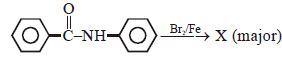
The order of $S_{N^1}$ reactivity in aqueous acetic acid solution for the compounds

$(1)$  $\begin{matrix}
   O\,\,\,\,\,\,\,\,\,\,\,  \\
   ||\,\,\,\,\,\,\,\,\,\,\,\,  \\
   {{H}_{3}}C-C-C{{H}_{2}}-Cl  \\
\end{matrix}$

$(2)$  ${{H}_{2}}C-C{{H}_{2}}-C{{H}_{2}}-Cl$

$(3)$  ${{({{H}_{3}}C)}_{3}}C-Cl$

Oxalic acid on being heated upto ${90\,^o}C$ with conc. ${H_2}S{O_4}$ forms
In a reaction, $n_1A + n_2B \to  m_1C + m_2D$ , $5\,M$ of reactant $A$ are allowed to react with $3\,M$ of reactant $B$. After $5\, second$, the concentration of $A$ was found to be $4\,M$. Rate of decomposition $A$ and rate of formation of $D$ respectively
$D$ -Glucose $\overset {O{H^ - }} \longleftrightarrow $ $A + B; A$ and $B$ are