MCQ
For inelastic collision between two spherical rigid bodies
  • A
    the total kinetic energy is conserved
  • B
    the total potential energy is conserved
  • C
    the linear momentum is not conserved
  • the linear momentum is conserved

Answer

Correct option: D.
the linear momentum is conserved
d
In inelastic collision, linear momentum is conserved.

Need a full question paper?

Generate a complete, print-ready paper with questions like this in minutes — across 16+ boards, with answer keys.
Start Generating Free

Similar questions

A liquid of mass m and specific heat $c$ is heated to a temperature $2T.$ Another liquid of mass $m/2$ and specific heat $2c$ is heated to a temperature $T.$ If these two liquids are mixed, the resulting temperature of the mixture is
The volume of a gas at $20°C$ is $200\, ml$. If the temperature is reduced to $-20°C$ at constant pressure, its volume will be ...... $ml$
Inside a closed furnace held at a temperature of $400\,\, K,$ we have a black body. A hole of area $10\,\, cm^2$ is opened in the furnace so that sunlight starts falling on black body. The intensity of sunlight is $2000\, W/m^2.$ In the steady state
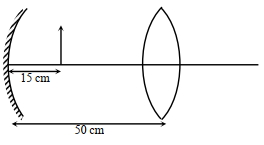
Consider a concave mirror and a convex lens (refractive index $=1.5$ ) of focal length $10 \ cm$ each, separated by a distance of $50 \ cm$ in air (refractive index $=1$ ) as shown in the figure. An object is placed at a distance of $15 \ cm$ from the mirror. Its erect image formed by this combination has magnification $M _1$. When the set- up is kept in a medium of refractive index $7 / 6$, the magnification becomes $M _2$. The magnitude $\left|\frac{ M _2}{ M _1}\right|$ is
Choose the answer that has correctly identified the number of acetals and  hemiacetals in isomaltose.

Acetal $-$ Hemiacetal

The radius of the orbital of electron in the hydrogen atom $0.5 Å$. The speed of the electron is $2 \times {10^6}m/s$. Then the current in the loop due to the motion of the electron is ............. $mA$
$Assertion :$ The ratio of $\frac{C_p}{C_v}$ for an ideal diatomic gas is less than that for an ideal monoatomic gas (where $C_p$ and $C_v$ have usual meaning).
$Reason :$ The atoms of a monoatomic gas have less degrees of freedom as compared to molecules of the diatomic gas.
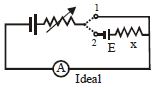
In the circuit shown the variable resistance is so adjusted that the ammeter reading is same in both the position $1$ and $2$ of the key. The reading of ammeter is $2A$. If $E = 20V$, then $x$ is :- ................... $\Omega$
Match List $- I$ (Fundamental Experiment) with List $- II$ (its conclusion) and select the correct option from the choices given below the list

$\begin{array}{|p{0.35\linewidth}|p{0.55\linewidth}|} \hline List\,\,-1  & List\,\,-II\,\,  \\ \hline a\,\,Franck-Hertz\,\,Experiment & i\,\,Particle\,\,nature\,\,of\,\,light \\ \hline b\,\,Photo\,\,-electric\,\,Experiment & ii\,\,Discrete\,\,energy \,\, levels\,\,of\,\,atom \\ \hline c\,\,Davison-Germer\,\,Experiment & iii\,\,Wave\,\,nature\,\,of\,\,electron \\ \hline  & iv\,\,Structure\,\,of\,\,atom  \\ \hline \end{array}$
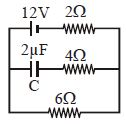
Find the charge on the capacitor $C$ in the following circuit ............ $\mu C$