Question
For light diverging from a point source:

Answer

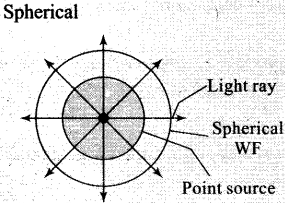
  1. The wavefront is spherical.
  2. The intensity decreases in proportion to the distance squared.
Solution:
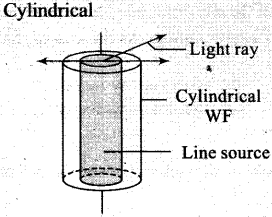
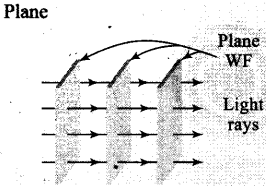
Type of wavefront Intensity Amplitude
$\text{I}\propto\frac{1}{\text{r}^2}$ $\text{A}\propto\frac{1}{\text{r}}$
$\text{I}\propto\frac{1}{\text{r}}$ $\text{A}\propto\frac{1}{\sqrt{\text{r}}}$
$\text{I}\propto\text{r}^0$ $\text{A}\propto\text{r}^0$
Due to the point source light propagates in all directions symmetrically and hence, wevefront will be spherical as shown in the diagram.
As intensity of the source will be,
$\text{I}\propto\frac{1}{\text{r}^2}$
where, r is radius of the wavefront at any time
Hence the intensity decreases in proportion to the distance squared.

Need a full question paper?

Generate a complete, print-ready paper with questions like this in minutes — across 16+ boards, with answer keys.

Start Generating Free

Similar questions

Assertion :  Electric field outside the conducting wire which carries a constant current is zero.
Reason    : Net charge on conducting wire is zero.(a) If both assertion and reason are true and the reason is the correct explanation of the assertion.(b) If both assertion and reason are true but reason is not the correct explanation of the assertion.(c) If assertion is true but reason is false.(d) If the assertion and reason both are false.


A capacitor when filled with a dielectric $K = 3$ has charge $Q_0,$ voltage $V_0$ and field $E_0$. If the dielectric is replaced with another one having $K = 9$  the new values of charge, voltage and field will be respectively
A convex lens is dipped in a liquid whose refractive index is equal to the refractive index of the lens. Then its focal length will:
Two protons are kept at a separation of $10\ nm.$ Let $F_n$ and $F_e$ be the nuclear force and the electromagnetic force between them:
Ultraviolet rays coming from sun are absorbed by:
The mass number of a nucleus is$:$
When light is refracted from air into glass(a) Its wavelength and frequency both increase(b) Its wavelength increases but frequency remains unchanged(c) Its wavelength decreases but frequency remains unchanged(d) Its wavelength and frequency both decrease


A magnetic field can be produced by(a) A moving charge(b) A changing electric field(c) None of these(d) Both of these
   
   
A magnetic dipole is under the influence of two magnetic fields The angle between the field directions is $60^\circ$ and one of the fields has a magnitude of $1.2 \times 10^{–2}T.$ If the dipole comes to stable equilibrium at an angle of $15^\circ$ with this field, what is the magnitude of other field?
The ratio of magnetic fields due to a small bar magnet in the end on position to the broad side on position is