MCQ
For light diverging from a point source:
- AThe wavefront is spherical.
- BThe intensity decreases in proportion to the distance squared.
- CThe wavefront is parabolic.
- DThe intensity at the wavefront does not depend on the distance.
Solution:
| Type of wavefront | Intensity | Amplitude |
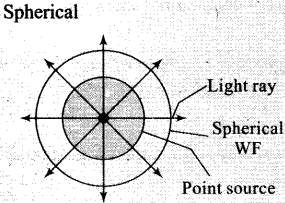 | $\text{I}\propto\frac{1}{\text{r}^2}$ | $\text{A}\propto\frac{1}{\text{r}}$ |
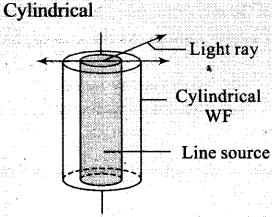 | $\text{I}\propto\frac{1}{\text{r}}$ | $\text{A}\propto\frac{1}{\sqrt{\text{r}}}$ |
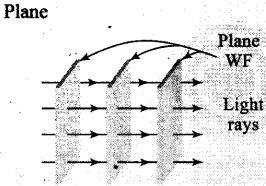 | $\text{I}\propto\text{r}^0$ | $\text{A}\propto\text{r}^0$ |
Due to the point source light propagates in all directions symmetrically and hence, wevefront will be spherical as shown in the diagram.
As intensity of the source will be,
$\text{I}\propto\frac{1}{\text{r}^2}$
where, r is radius of the wavefront at any time
Hence the intensity decreases in proportion to the distance squared.
Generate a complete, print-ready paper with questions like this in minutes — across 16+ boards, with answer keys.
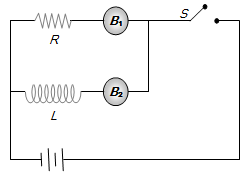
The adjoining figure shows two bulbs B1 and B2 resistor R and an inductor L. When the switch S is turned off
|
(a) Both B1 and B2 die out promptly |
|
(b) Both B1 and B2 die out with some delay |
|
(c) B1 dies out promptly but B2 with some delay |
|
(d) B2 dies out promptly but B1 with some delay |
A charge Q is divided into two parts of q and Q - q. If the coulomb repulsion between them when they are separated is to be maximum, the ratio of  should be
|
(a) 2 |
(b) 1/2 |
(c) 4 |
(d) 1/4 |
A convex lens makes a real image 4 cm long on a screen. When the lens is shifted to a new position without disturbing the object, we again get a real image on the screen which is 16 cm tall. The length of the object must be
|
(a) 1/4 cm |
(b) 8 cm |
(c) 12 cm |
(d) 20 cm |
The addition of antimony atoms to a sample of intrinsic germanium transforms it to a material which is
|
(a) Superconductor |
(b) An insulator |
|
(c) N-type semiconductor |
(d) P-type semiconductor |
A battery having e.m.f. 5V and internal resistance 0.5 W is connected with a resistance of 4.5 W then the voltage at the terminals of battery is
|
(a) 4.5 V |
(b) 4 V |
(c) 0 V |
(d) 2 V |