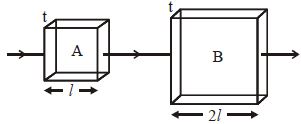
For measurement of potential difference, potentiometer is preferred in comparison to voltmeter because
Easy


Download our appand get started for free
Experience the future of education. Simply download our apps or reach out to us for more information. Let's shape the future of learning together!No signup needed.*
Similar Questions
- 1The charge flowing through a resistance $R$ varies with time $t$ as $ Q=at-bt^2 $ where $a$ and $b$ are positive constants . The total heat produced in $R$ isView Solution
- 2A uniform wire of resistance $9$ $\Omega$ is cut into $3$ equal parts. They are connected in the form of equilateral triangle $ABC$. A cell of $e.m.f.$ $2\,V$ and negligible internal resistance is connected across $B$ and $C$. Potential difference across $AB$ is ............... $V$View Solution
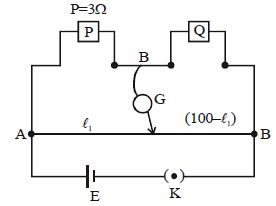
- 3In a meter bridge experiment, resistances are connected as shown in the following figure. The balancing length $l_1$ is $55\, cm$. Now, an unknown resistance $x$ is connected in series with $P$ and the new balancing length is found to be $75\, cm$. The value of $x$ isView Solution
- 4An electric kettle has two coils. When one of these is switched on, the water in the kettle boils in $6\,\min$ . When the other coil is switched on, the water boils in $3\,\min$. If the two coils are connected in series, the time taken to boil the water in the kettle is ............. $min$View Solution
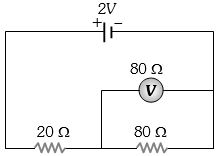
- 5In the adjoining circuit, the $e.m.f.$ of the cell is $2\, volt$ and the internal resistance is negligible. The resistance of the voltmeter is $80 \,ohm$. The reading of the voltmeter will be ............. $volt$View Solution
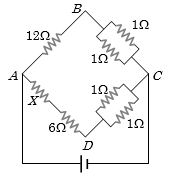
- 6For what value of unknown resistance $X$, the potential difference between $B$ and $D$ will be zero in the circuit shown in the figure ............... $\Omega$View Solution
- 7In the diagram resistance between any two junctions is $R$. Equivalent resistance across terminals $A$ and $B$ isView Solution

- 8A letter $A$ is constructed of a uniform wire with resistance $1.0\,\Omega \,per\,cm$. The sides of the letter are $20\, cm$ and the cross piece in the middle is $10\, cm$ long. The apex angle is $60^o$. The resistance between the ends is .............. $\Omega$View Solution
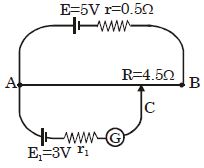
- 9In the given potentiometer circuit length of the wire $AB$ is $3\,m$ and resistance is $R = 4.5 \,\Omega.$ The length $AC$ for no deflection in galvanometer is ................ $\mathrm{m}$View Solution
- 10Two square metal plates $A$ and $B$ are of the same thickness and material. The side of $B$ is twice that of $A$. These are connected as shown in series. If the resistances of $A$ and $B$ are denoted by $R_A$ and $R_B,$ then $(R_A/R_B)$ isView Solution