MCQ
For non-conductors, the energy gap is
  • $6\, eV$
  • B
    $1.1 \,eV$
  • C
    $0.8\, eV$
  • D
    $0.3 \,eV$

Answer

Correct option: A.
$6\, eV$
a
(a)

Need a full question paper?

Generate a complete, print-ready paper with questions like this in minutes — across 16+ boards, with answer keys.
Start Generating Free

Similar questions

The wavefronts of light coming from a distant source of unknown shape are nearly:
The mutual inductance between two coils is 1.25 henry. If the current in the primary changes at the rate of 80 ampere/second, then the induced e.m.f. in the secondary is
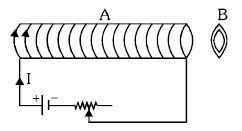
An aluminium ring $B$ faces an electromagnet $A$. The current $I$ through $A$ can be altered. Then which of the following statement is correct
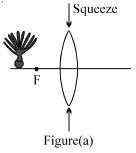
$A$ turnip sits before a thin converging lens, outside the focal point of the lens. The lens is filled with a transparent gel so that it is flexible; by squeezing its ends toward its center [as indicated in figure $(a)$], you can change the curvature of its front and rear sides. When you squeeze the lens, the image.
A concave mirror of focal length $f$ produces an image $n$ times the size of the object. If the image is real then the distance of the object from the mirror is
A nucleus is bombarded with a high speed neutron so that resulting nucleus is a radioactive one. This phenomenon is called
Two charges $ + 5\,\mu C$ and $ + 10\,\mu C$ are placed $20\, cm$ apart. The net electric field at the mid-Point between the two charges is
A silver ball of radius $4.8\ cm$ is suspended by a thread in the vacuum chamber. $UV$ light of wavelength $200\ nm$ is incident on the ball for some times during which a total energy of $1 × 10^{-7} \ J$ falls on the surface. Assuming on an average one out of $10^3$ photons incident is able to eject electron. The potential on sphere will be ............ $V$ 
Image of an object approaching a convex mirror of radius of curvature $20\  m$ along its optical axis is observed to move from $\frac{{25}}{3}\ m$ to $\frac{{25}}{3}\ m$ in $30\  seconds$. What is the speed of the object in $km$ per hour ?
A cell whose e.m.f. is $2\, V$ and internal resistance is $0.1\,\Omega $, is connected with a resistance of $3.9\,\Omega $. The voltage across the cell terminal will be ................ $V$