Question
For nuclei with A > 100:

Answer

  1. The binding energy per nucleon decreases on an average as A increases.
  2. If the nucleus breaks into two roughly equal parts, energy is released.
Explanation:
Binding energy per nucleon varies in a way that it depends on the actual value of mass number (A). As the mass number (A) increases, the binding energy also increases and reaches its maximum value of 8.7MeV for A(50-80) and for A > 100. The binding energy per nucleon decreases as A increases and the nucleus breaks into two or more atoms of roughly equal parts so as to attain stability and binding energy of mass number between 50-80.

Need a full question paper?

Generate a complete, print-ready paper with questions like this in minutes — across 16+ boards, with answer keys.
Start Generating Free

Similar questions

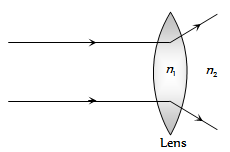
The relation between $n_1$ and $n_2,$ if behaviour of light rays is as shown in figure is

 
Displacement current is.
The radius of curvature of convex surface of a thin plano-convex lens is 15 cm and refractive index of its material is 1.6. The power of the lens will be(a) + 1D (b) -2D (c) +3D (d) +4D
       
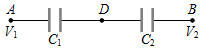
Two condensers $C _1$ and $C _2$ in a circuit are joined as shown in figure. The potential of point $A$ is $V _1$ and that of B is $V _2$. The potential of point $D$ will be
Which of the following mirrors always forms a virtual and small image?
Assertion  :   Circuit containing capacitors should be handled cautiously even when there is no current.
Reason      : The capacitors are very delicate and so quickly break down.(a) If both assertion and reason are true and the reason is the correct explanation of the assertion.(b) If both assertion and reason are true but reason is not the correct explanation of the assertion.(c) If assertion is true but reason is false.(d) If the assertion and reason both are false.


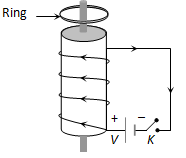
A conducting ring is placed around the core of an electromagnet as shown in fig. When key $K$ is pressed, the ring
 
The specific heat capacity of a body depends on:
  1. The heat give.
  2. The temperature raised.
  3. The mass of the body.
  4. The material of the body.
Control rods used in nuclear reactors are made of:
The idea of secondary wavelets for the propagation of a wave was first given by (a) Newton(b) Huygen(c) Maxwell(d) Fresnel