MCQ
For nuclei with A > 100:
  • A
    The binding energy of the nucleus decreases on an average as A increases.
  • B
    The binding energy per nucleon decreases on an average as A increases.
  • C
    If the nucleus breaks into two roughly equal parts, energy is released.
  • D
    If two nuclei fuse to form a bigger nucleus, energy is released.
Answer

  1. The binding energy per nucleon decreases on an average as A increases.
  2. If the nucleus breaks into two roughly equal parts, energy is released.

Explanation:

Binding energy per nucleon varies in a way that it depends on the actual value of mass number (A). As the mass number (A) increases, the binding energy also increases and reaches its maximum value of 8.7MeV for A(50-80) and for A > 100. The binding energy per nucleon decreases as A increases and the nucleus breaks into two or more atoms of roughly equal parts so as to attain stability and binding energy of mass number between 50-80.

Need a full question paper?

Generate a complete, print-ready paper with questions like this in minutes — across 16+ boards, with answer keys.

Start Generating Free

Similar questions

The dimensional formula of $\frac{1}{2}\in_{0}E^{2}$ is identical to :

A nuclear bomb exploded 200 km above the surface of moon. The sound of explosion on the moon

(a) Will heard before the explosion is seen

(b) Will be heard at the same time

(c) Will be heard after explosion

(d) Will not heard at all

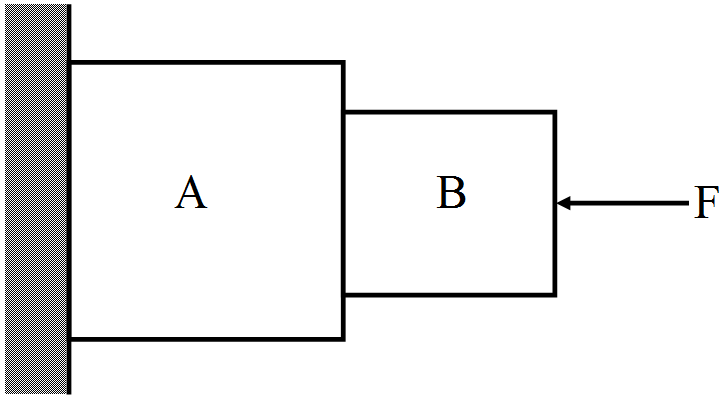
Consider the situation shown in figure. The wall smooth but the surface of A and B in contact are rough. The friction on B due to A in equilibrium:

  1. Is upward.
  2. Is downward.
  3. Is zero.
  4. The system cannot remain in equilibrium.

In an atomic bomb, the energy is released due to

(a) Chain reaction of neutrons and  

(b) Chain reaction of neutrons and  

(c) Chain reaction of neutrons and  

(d) Chain reaction of neutrons and  

The magnitude of electric field intensity E is such that, an electron placed in it would experience an electrical force equal to its weight is given by

(a) mge

(b)  

(c)  

(d)  

If there is no external force acting on a nonrigid body, which of the following quantities must remain constant?
  1. Angular momentum.
  2. Linear momentum.
  3. Kinetic energy.
  4. Moment of inertia.
In a cathode ray tube, the screen is coated with fluorescent material:
Maximum value of voltage in an ac circuit is 282 V. The effective magnitude of voltage is:
A bar-magnet of the pole-strength $2 Amp - m$ is kept in a magnetic field of induction $4 \times 10^{-5} Wb / m ^2$ such that the axis of the magnet makes an angle $30^{\circ}$ with the direction of the field. If the couple acting on the magnet is found to be $80 \times 10^{-7} Nm$, then the distance between the poles of the magnet is:
An inductor, a resistor and a capacitor are joined in series with an AC source. As the frequency of the source is slightly increased from a very low value, the reactance of the.