Question
For question two statements are given-one labelled Assertion (A) and the other labelled Reason (R). Select the correct answer to these questions from the codes (a), (b), (c) and (d) as given below.
  1. Both A and R are true, and R is the correct explanation of A.
  2. Both A and R are true, but R is NOT the correct explanation of A.
  3. A is true, but R is false.
  4. A is false and R is also false.
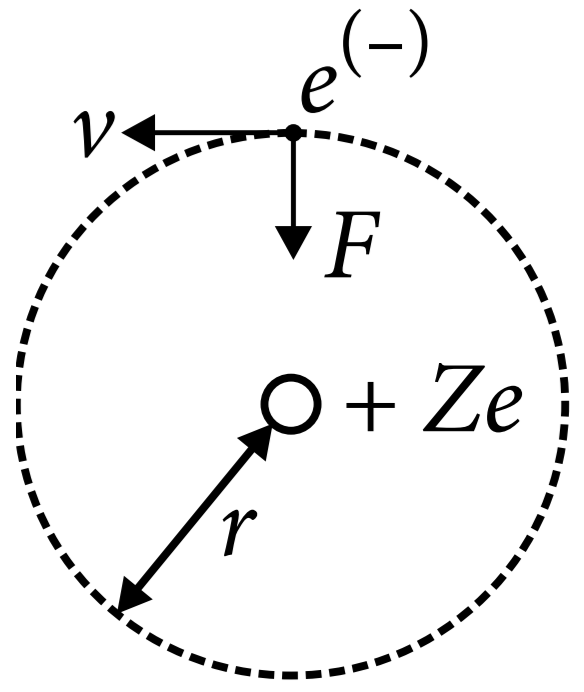
Assertion (A): Electrons in the atom are held due to coulomb forces.
Reason (R): The atom is stable only because the centripetal force due to Coulomb's law is balanced by the centrifugal force.
Answer

  1. A is true, but R is false.

Explanation:
According to postulates of Bohr's atom model, the electron revolve around the nucleus in fixed orbit of definite radii. As long as the electron is In a certain orbits it does not radiate any energy. Not only the centripetal force has to be the centrifugal force, even the stable orbits are fixed by Bohr's theory.

Need a full question paper?

Generate a complete, print-ready paper with questions like this in minutes — across 16+ boards, with answer keys.

Start Generating Free

Similar questions

For question two statements are given-one labelled Assertion (A) and the other labelled Reason (R). Select the correct answer to these questions from the codes (a), (b), (c) and (d) as given below.
  1. Both A and R are true and R is the correct explanation of A.
  2. Both A and R are true but R is NOT the correct explanation of A.
  3. A is true but R is false.
  4. A is false and R is also false.
Assertion (A): In interference all the fringes are of same width.
Reason (R): In interference fringe width is independent of position of the fringe.
For two statements are given$-$one labelled Assertion $(A)$ and the other labelled Reason $(R).$ Select the correct answer to these questions from the codes $(a), (b), (c)$ and $(d)$ as given below.
Assertion $(A)$: If there exists coulomb attraction between two bodies, both of them may not be charged.
Reason $(R):$ ln coulomb attraction two bodies are oppositely charged.
Two statements are given-one labelled Assertion (A) and the other labelled Reason (R). Select the correct answer to these questions from thecodes(a), (b), (c) and (d) as given below.
  1. Both A and R are true and R is the correct explanation of A.
  2. Both A and R are true but R is not the correct explanation of A.
  3. A is true but R is false.
  4. A is false and R is also false.
Assertion: The probability of electrons to be found in the conduction band of an intrinsic semiconductor at a finite temperature decrease exponentially with increasing band gap.
Reason: It will be more difficult for the electron to cross over the large band gap while going from valence band to conduction band.
For question, statements are given-one labelled Assertion $(A)$ and the other labelled Reason $(R)$. Select the correct answer to these questions from the codes $(a) (b) (c)$ and $(d)$ as given below. Assertion $(A$): The ratio for time taken for light emission from an atom to that for release of nuclear energy in fission is $1 : 100$.
Reason $(R)$: Time taken for the light emission from an atom is of the order of $10^{-8}s$.
For two statements are given-one labelled Assertion (A) and the other labelled Reason (R). Select the correct answer to these questions from the codes (a), (b), (c) and (d) as given below.
  1. Both A and R are true, and R is the correct explanation of A.
  2. Both A and R are true, but R is not the correct explanation of A.
  3. A is true, but R is false.
  4. A is false, and R is also false.
Assertion (A): Increasing the charge on the plates of a capacitor means increasing the capacitance.
Reason (R): Capacitance is directly proportional to charge.
For two statements are given-one labelled Assertion (A) and the other labelled Reason (R). Select the correct answer to these questions from the codes (a), (b), (c) and (d) as given below.
  1. Both A and R are true, and R is the correct explanation of A.
  2. Both A and R are true, but R is not the correct explanation of A.
  3. A is true, but R is false.
  4. A is false, and R is also false.
Assertion (A): A capacitor is connected to a battery. If we move its plate further apart, work will be done against the electrostatic attraction between the plates, and the energy of the capacitor gets decreased.
Reason (R): The energy stored in capacitor is dissipated in the form of heat energy.
Two statements are given-one labelled Assertion (A) and the other labelled Reason (R). Select the correct answer to these questions from the codes (a), (b), (c) and (d) as given below.
  1. Both A and R are true and R is the correct explanation of A.
  2. Both A and R are true but R is not the correct explanation of A.
  3. A is true but R is false.
  4. A is false and R is also false.
Assertion: The electric field and magnetic field have equal average values in linearly polarised plane em wave.
Reason: The electric energy and magnetic energy have equal average values in linearly polarised plane em wave.
Assertion (A): According to Huygen’s principle, no backward wave-front is possible.
Reason (R): Amplitude of secondary wavelet is proportional to $(1+\cos \theta)$ where $\theta$ is the angle between the ray at the point of consideration and the direction of secondary wavelet.
For question two statements are given-one labelled Assertion (A) and the other labelled Reason (R). Select the correct answer to these questions from the codes (a), (b), (c) and (d) as given below.
  1. Both A and R are true, and R is the correct explanation of A.
  2. Both A and R are true, but R is NOT the correct explanation of A.
  3. A is true, but R is false.
  4. A is false and R is also false.
Assertion (A): Fraunhofer lines are observed in the spectrum of the sun.
Reason (R): The different elements have different spectra.
Assertion (A): The dc and ac both can be measured by a hot wire instrument.
Reason (R): The hot wire instrument is based on the principle of magnetic effect of current.