MCQ
For question two statements are given $-$ one labelled Assertion $(A)$ and the other labelled Reason $(R)$. Select the correct answer to these questions from the codes $(a), (b), (c)$ and $(d)$ as given below.
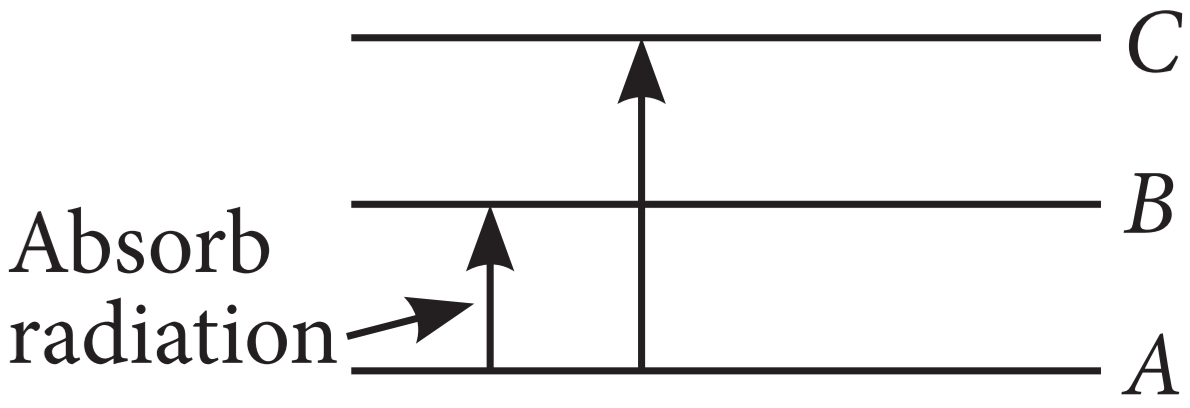
Assertion $(A)$ : Between any two given energy levels, the number of absorption transitions is always less than the number of emission transitions.
Reason $(R)$ : Absorption transitions start from the lowest energy level only and may end at any higher energy level. But emission transitions may start from any higher energy level and end at any energy level below it.
  • Both $A$ and $R$ are true, and $R$ is the correct explanation of $A$.
  • B
    Both $A$ and $R$ are true, but $R$ is $\text{NOT}$ the correct explanation of $A$.
  • C
    $A$ is true, but $R$ is false.
  • D
    $A$ is false and $R$ is also false.

Answer

Correct option: A.
Both $A$ and $R$ are true, and $R$ is the correct explanation of $A$.
Both $A$ and $R$ are true, and $R$ is the correct explanation of $A.$
Absorption transition

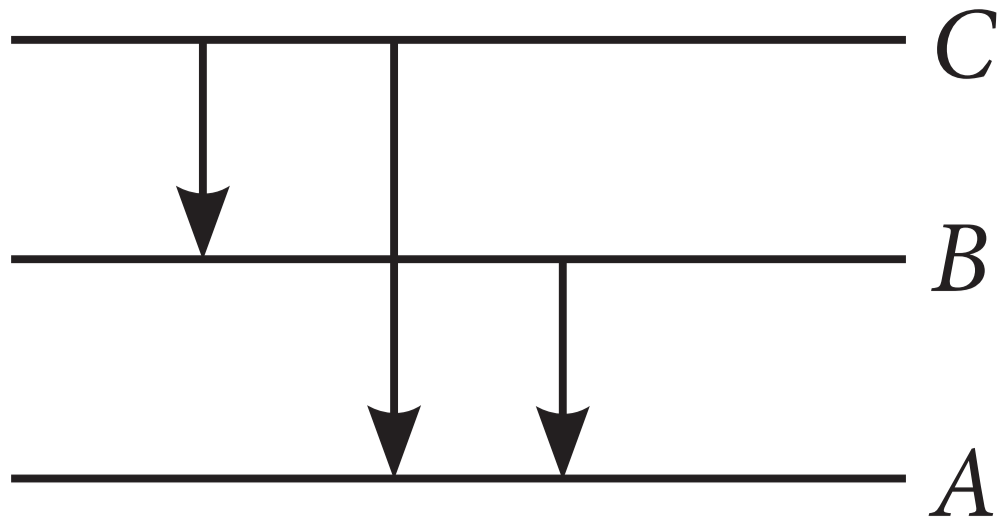
Two possibilities in absorption transition. Emission transition

Three possibilities in emission transition.
Therefore, number of absorption transition $ < $ number of emission transition.
For any two states $A$ and $B$ such that $E_A < E_8$
We have absorption spectrum for $A ​​\rightarrow B$ transition and emission $B \rightarrow A$.
But most of the time atoms are in ground state, absorption is only from the ground state.

Need a full question paper?

Generate a complete, print-ready paper with questions like this in minutes — across 16+ boards, with answer keys.

Start Generating Free

Similar questions

Two statements are given-one labelled Assertion (A) and the other labelled Reason (R). Select the correct answer to these questions from thecodes(a), (b), (c) and (d) as given below.
  1. Both A and R are true and R is the correct explanation of A.
  2. Both A and R are true but R is not the correct explanation of A.
  3. A is true but R is false.
  4. A is false and R is also false.
Assertion: The ratio of free electrons to holes in intrinsic semiconductor is greater than one.
Reason: The electrons are lighter particles and holes are heavy particles.
For question two statements are given-one labelled Assertion (A) and the other labelled Reason (R). Select the correct answer to these questions front the codes (a), (b), (c) and (d) as given below.
  1. Both A and R are true and R is the correct explanation of A.
  2. Both A and R are true but R is NOT the correct explanation of A.
  3. A is true but R is false.
  4. A is false and R is also false.
Assertion (A): Work function of aluminium is 4.2eV. Emission of electrons will not be possible if two photons each of energy 2.5eV strike an electron of aluminium.
Reason (R): For photoelectric emission the energy of each photon should be greater than the work function of aluminium.
Assertion (A): At resonance, the inductive reactance is equal and opposite to the capacitive reactance.
Reason (R): In series LCR-circuit, the inductive reactance is equal and opposite to the capacitive reactance
For two statements are given-one labelled Assertion (A) and the other labelled Reason (R). Select the correct answer to these questions from the codes (a), (b), (c) and (d) as given below.
  1. Both A and R are true, and R is the correct explanation of A.
  2. Both A and R are true, but R is not the correct explanation of A.
  3. A is true but R is false.
  4. A is false and R is also false.
Assertion (A): Electric force acting on a proton and an electron, moving in a uniform electric field is the same, where as acceleration of electron is 1836 times that of a proton.
Reason (R): Electron is lighter than proton.
Two statements are given-one labelled Assertion(A) and the other labelled Reason (R). Select the correct answer to these questions from the codes(a), (b), (c) and (d) as given below.
  1. Both A and R are true and R is the correct explanation of A.
  2. Both A and R are true but R is NOT the correct explanation of A.
  3. A is true but R is false.
  4. A is false and R is also false.
Assertion (A): Earth's magnetic field does not affect the working of a moving coil galvanometer.
Reason (R): The earth's magnetic field is quite weak as compared to magnetic field produced in the moving coil galvanometer.
Assertion (A): The photoelectrons produced by a monochromatic light beam incident on a metal surface have a spread in their kinetic energies.
Reason (R): The energy of electrons emitted from inside the metal surface, is lost in collision with the other atoms in the metal.
For two statements are given-one labelled Assertion (A) and the other labelled Reason (R). Select the correct answer to these questions from the codes (a), (b), (c) and (d) as given below.
  1. Both A and R are true, and R is the correct explanation of A.
  2. Both A and R are true, but R is not the correct explanation of A.
  3. A is true, but R is false.
  4. A is false, and R is also false.
Assertion (A): Conductors having equal positive charge and volume, must also have same potential.
Reason (R): Potential depends only on charge and volume of conductor.
For question, statements are given-one labelled Assertion (A) and the other labelled Reason (R). Select the correct answer to these questions from the codes (a) (b) (c) and (d) as given below.
  1. Both A and R are true, and R is the correct explanation of A.
  2. Both A and R are true, but R is NOT the correct explanation of A.
  3. A is true, but R is false.
  4. A is false and R is also false.
Assertion (A): For the fission of heavy nuclei, neutrons are more effective than protons.
Reason (R): Neutrons are heavier than protons.
For two statements are given-one labelled Assertion (A) and the other labelled Reason (R). Select the correct answer to these questions from the codes (a), (b), (c) and (d) as given below.
  1. Both A and R are true, and R is the correct explanation of A.
  2. Both A and R are true, but R is not the correct explanation of A.
  3. A is true, but R is false.
  4. A is false, and R is also false.
Assertion: The temperature coefficient of resistance is always positive only for metals.
Reason: On increasing the temperature, the resistance of metals and alloys increases.
Two statements are given-one labelled Assertion (A) and the other labelled Reason (R). Select the correct answer to these questions from the codes (a), (b), (c) and (d) as given below.
  1. Both A and R are true and R is the correct explanation of A.
  2. Both A and R are true but R is NOT the correct explanation of A.
  3. A is true but R is false.
  4. A is false and R is also false.
Assertion (A): When a magnetic dipole is placed in a non uniform magnetic field, only a torque acts on the dipole.
Reason (R): Force would act on dipole if magnetic field is uniform.