Question
For question two statements are given-one labelled Assertion (A) and the other labelled Reason (R). Select the correct answer to these questions from the codes (a), (b), (c) and (d) as given below.

  1. Both A and R are true, and R is the correct explanation of A.
  2. Both A and R are true, but R is NOT the correct explanation of A.
  3. A is true, but R is false.
  4. A is false and R is also false.

Assertion (A): Between any two given energy levels, the number of absorption transitions is always less than the number of emission transitions.

Reason (R): Absorption transitions start from the lowest energy level only and may end at any higher energy level. But emission transitions may start from any higher energy level and end at any energy level below it.
Answer

  1. Both A and R are true, and R is the correct explanation of A.

Explanation:

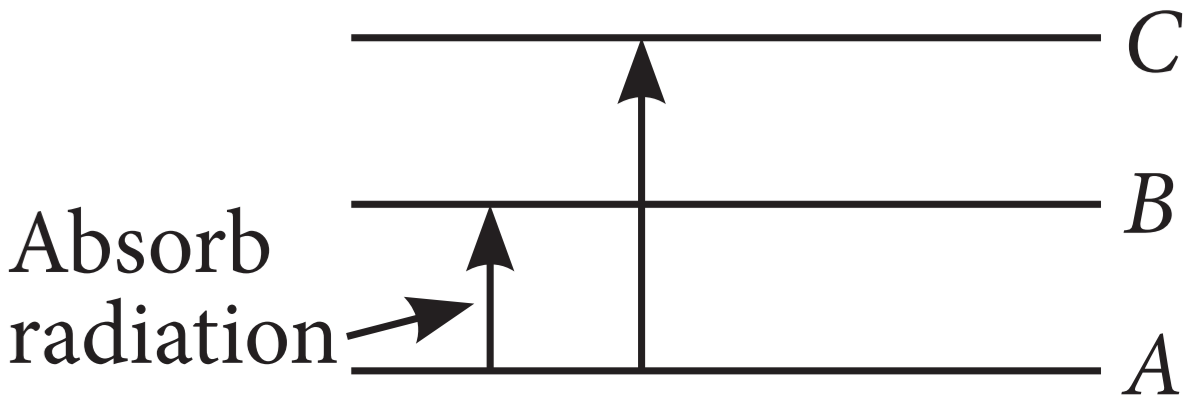
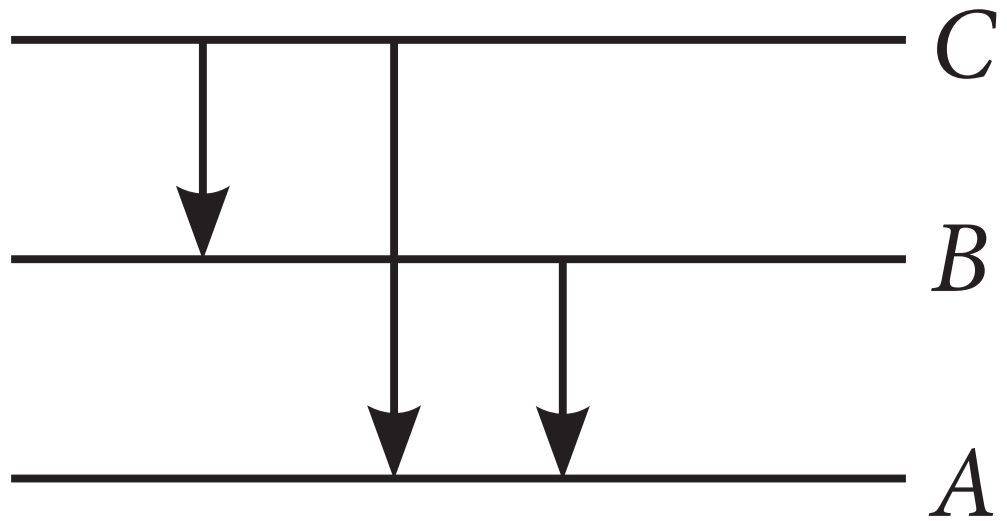
Absorption transition 

Two possibilities in absorption transition. Emission transition

Three possibilities in emission transition. Therefore, number of absorption transition < number of emission transition. For any two states A and B such that EA < E8 we have absorption spectrum for A → B transition and emission B → A. But most of the time atoms are in ground state, absorption is only from the ground state.

Need a full question paper?

Generate a complete, print-ready paper with questions like this in minutes — across 16+ boards, with answer keys.

Start Generating Free

Similar questions

For two statements are given-one labelled Assertion (A) and the other labelled Reason (R). Select the correct answer to these questions from the codes (a), (b), (c) and (d) as given below.
  1. Both A and R are true, and R is the correct explanation of A.
  2. Both A and R are true, but R is not the correct explanation of A.
  3. A is true but R is false.
  4. A is false and R is also false.
Assertion (A): The electric flux emanating out and entering a closed surface are 8 × 103 and 2 × 10³Vm respectively. The charge enclosed by the surface is $0.053\mu\text{C}.$
Reason (R): Gauss's theorem in electrostatics may be applied to verify.
For two statements are given-one labelled Assertion (A) and the other labelled Reason (R). Select the correct answer to these questions from the codes (a), (b), (c) and (d) as given below.
  1. Both A and R are true, and R is the correct explanation of A.
  2. Both A and R are true, but R is not the correct explanation of A.
  3. A is true, but R is false.
  4. A is false, and R is also false.
Assertion: Two electric bulbs of 50 and 100 watt are given. When connected in series 50 watt bulb glows more but when connected in parallel 100 watt bulb glows more.
Reason: In series combination, power is directly proportional to the resistance of circuit. But in parallel combination, power is inversely proportional to the resistance of the circuit.
For two statements are given-one labelled Assertion (A) and the other labelled Reason (R). Select the correct answer to these questions from the codes (a), (b), (c) and (d) as given below.
  1. Both A and R are true, and R is the correct explanation of A.
  2. Both A and R are true, but R is not the correct explanation of A.
  3. A is true, but R is false.
  4. A is false, and R is also false.
Assertion (A): The surface of a conductor is an equipotential surface.
Reason (R): Conductor allows the flow of charge.
For two statements are given-one labelled Assertion (A) and the other labelled Reason (R). Select the correct answer to these questions from the codes (a), (b), (c) and (d) as given below.
  1. Both A and R are true, and R is the correct explanation of A.
  2. Both A and R are true, but R is not the correct explanation of A.
  3. A is true but R is false.
  4. A is false and R is also false.
Assertion (A): A small metal ball is suspended in a uniform electric field with an insulated thread. If high-energy X-ray beam falls on the ball, the ball will be deflected in the electric field.
Reason (R): X-rays emits photoelectron and metal becomes negatively charged.
Assertion (A): To observe diffraction of light, the size of the obstacle/aperture should be of the order of $10^{-7} m$.
Reason (R): $10^{-7}$ is the order of the wavelength of visible light.
For question two statements are given-one labelled Assertion (A) and the other labelled Reason (R). Select the correct answer to these questions from the codes (a), (b), (c) and (d) as given below.

  1. Both A and R are true, and R is the correct explanation of A.
  2. Both A and R are true, but R is NOT the correct explanation of A.
  3. A is true, but R is false.
  4. A is false and R is also false.

Assertion (A): Laser is used to measure distant object like moon.

Reason (R): They are highly coherent source of light.

Assertion (A) :A step-up transformer cannot be used as a step-down transformer.
Reason (R): A transformer works only in one direction.
Two statements are given-one labelled Assertion (A) and the other labelled Reason (R). Select the correct answer to these questions from the codes (a), (b), (c) and (d) as given below.
  1. Both A and R are true and R is the correct explanation of A.
  2. Both A and R are true but R is not the correct explanation of A.
  3. A is true but R is false.
  4. A is false and R is also false.
Assertion: The focal length of an equiconvex lens placed in air is equal to radius of curvature of either face. Lens is made up of material of refractive index of 1.5.
Reason: For an equiconvex lens, radius of curvature of both the faces is same.
For two statements are given-one labelled Assertion (A) and the other labelled Reason (R). Select the correct answer to these questions from the codes (a), (b), (c) and (d) as given below.
  1. Both A and R are true, and R is the correct explanation of A.
  2. Both A and R are true, but R is not the correct explanation of A.
  3. A is true, but R is false.
  4. A is false, and R is also false.
Assertion (A): A capacitor can be broken by placing large amount of charge on it.
Reason (R): After breakage potential, the capacitor is destroyed.
Assertion (A): If a proton and electron are moving with same velocity, then wavelength of de-Broglie wave associated with electron is longer than that associated with proton.
Reason (R): The wavelength of de-Broglie wave associated with a moving particle is inversely proportional to its mass.