MCQ
For question two statements are given$-$one labelled Assertion and the other labelled Reason. Select the correct answer to these questions from the codes $(a), (b), (c)$ and $(d)$ as given below.
Assertion : Linked gene show dihybrid ratio of $9 : 3 : 3 : 1.$
Reason: Linked gene undergo independent assortment.
  • A
    Both assertion and reason are true and reason is the correct explanation of assertion.
  • B
    Both assertion and reason are true but reason is not the correct explanation of assertion.
  • C
    Assertion is true but reason is false.
  • Both assertion and reason are false.

Answer

Correct option: D.
Both assertion and reason are false.
Linked genes are those genes which occurs on the same chromosome while unlinked genes are the ones found on different chromosomes. Linked gene show dihybrid ratio of $3 : 1.$ Linked genes do not show independent assortment.

Need a full question paper?

Generate a complete, print-ready paper with questions like this in minutes — across 16+ boards, with answer keys.

Start Generating Free

Similar questions

For question, two statements are given$-$one labelled Assertion and the other labelled Reason. Select the correct answer to these questions from the codes $(a), (b), (c)$ and $(d)$ as given below.
Assertion : Tranquillizers are used to treat schizophrenia.
Reason: Tranquillizers are antipsychosis drugs.
For question, two statements are given$-$one labelled Assertion and the other labelled Reason. Select the correct answer to these questions from the codes $(a), (b), (c)$ and $(d)$ as given below.
Assertion :Mucous membrane immobilises the micro$-$organisms in the body
Reason: Microorganisms and dust particles entering the respiratory tract are trapped in the mucus.
For two statements are given$-$one labelled Assertion and the other labelled Reason. Select the correct answer to these questions from the codes $(a), (b), (c)$ and $(d)$ as given below.
Assertion: One pollen mother cell forms four microspores.
Reason: Microspores are formed due to reduction division.
Two statements are given $-$ one labelled Assertion and the other labelled Reason. Select the correct answer to these questions from the codes $(a), (b), (c)$ and $(d)$ as given below.
Assertion : Both the passenger and vehicle $\text{DNAs}$ are treated separately with separate restriction endonuclease.
Reason : Ligation is done by the use of alkaline phosphatase and $\text{DNA}$ ligase.
Read the following and answer any four questions from $(i)$ to $(v)$ given below:
The pollen grains or microspores are the male reproductive bodies of a flower and are contained in the pollen sac or microsporangia. Each pollen grain consists of a single microscopic cell, possessing two coats: the exine and the in tine. The exine of a pollen grain is made of chemically stable material. Because of this, pollen grains are often very well preserved for thousands of years in soil and sediments.
  1. One of the most resistant biological material present in the exine of pollen grain is:
  1. Pectocellulose.
  2. Sporopollenin.
  3. Suberin.
  4. Cellulose.
  1. The exine possesses one or more thin places known as:
  1. Raphe.
  2. Germ pores.
  3. Hilum.
  4. Endothecium.
  1. What is the function of germ pore?
  1. Emergence of radicle.
  2. Absorption of water for seed germination.
  3. Initiation of pollen tube.
  4. All of these.
  1. What is the key advantage to the plant for having such strong pollen grain walls?
  1. It protects the vital genetic material in the pollen grain.
  2. It allows pollen to serve as a valuable fossil record for the study of ancient plants.
  3. It prevents the pollen tube from growing out before the pollen grain reaches the stigma of a compatible species.
  4. It gives weight to the pollen grain, allowing it to cling better to the body surfaces of insect pollinators.
  1. The number of germ pores in dicots and monocots respectively are:
  1. One and three.
  2. Three and two.
  3. Two and three.
  4. Three and one.
For two statements are given$-$one labelled Assertion and the other labelled Reason. Select the correct answer to these questions from the codes $(a), (b), (c)$ and $(d)$ as given below.
Assertion: Rhythm contraceptive method can be beneficial to the couple facing fertility problem.
Reason: Rhythm method is based on the $\text{ICSI}$ technique.
Silencing of a gene could be achieved through the use of :
Read the following and answer any four questions from $(i)$ to $(v)$ given below:
A typical angiospermic ovule is a small structure attached to the placenta by means of a stalk called funicle. The body of the ovule fuses with funicle in the region called hilum. Each ovule has one or two protective envelopes called integuments. Integuments encircle the nucellus except at the tip where a small opening called the micropyle is formed. Mature ovules are classified on the basis of funiculus. It can be orthotropous, anadromous, hernitropous, campylotropous, etc.
  1. The body of the ovule consists of a mass of parenchymatous cells called:
  1. Integuments.
  2. Nucellus.
  3. Hilum.
  4. Funiculus.
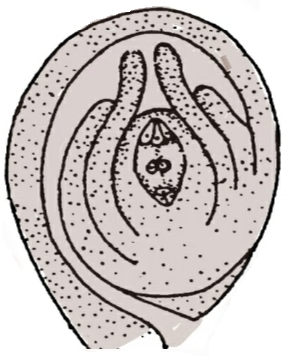
  1. Refer to the given figure and select the correct statement regarding it.
  1. This type of ovule is found in cactus.
  2. The micropyle comes to lie close to the funiculus due to unilateral growth of ovule.
  3. It is most common type of ovule found in the members of Chenopodiaceae.
  4. It is half inverted ovule.
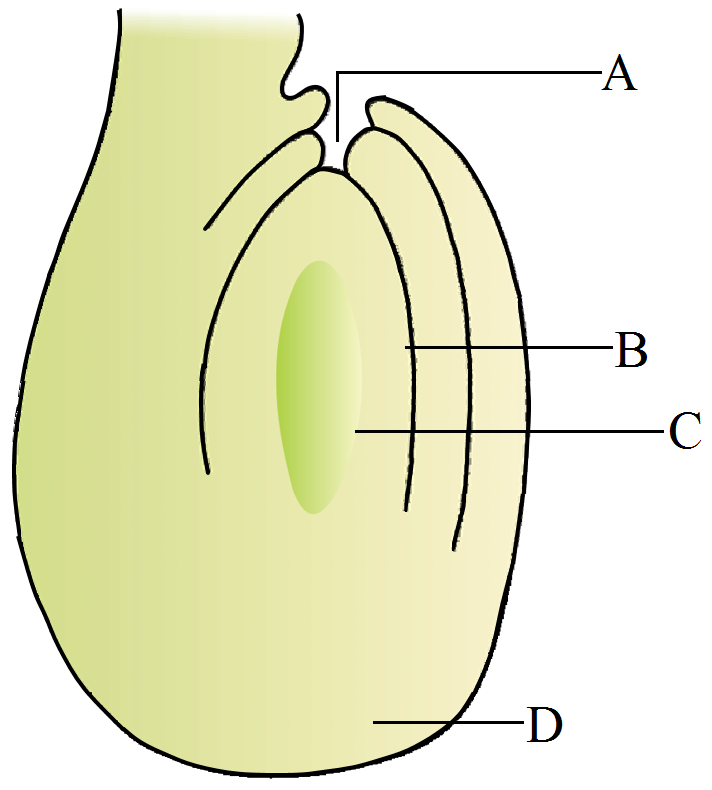
  1. Identify the parts labelled as $A, B, C$ and $D$ in the given figure and select the correct option.
S. No $A$ $B$ $C$ $D$
$(a)$ Chalaza Female gametophyte Embryo sac Micropyle
$(b)$ Chalaza NuceIIus Embryo sac Micropyle
$(c)$ Micropyle Egg Embryo sac Chalaza
$(d)$ Micropyle Nucellus Embryo sac Chalaza
  1. Mature ovules are classified on the basis of funiculus. If micropyle lie close to the funiculus, the ovule is termed as:
  1. Orthotropous.
  2. Anatropous.
  3. Hemitropous.
  4. Campylotropous.
  1. In Asphodel us, ovule is:
  1. Unitegmic.
  2. Tritegmic.
  3. Bitegmic.
  4. Ategmic.
For question two statements are given-one labelled Assertion and the other labelled Reason. Select the correct answer to these questions from the codes $\text{(a), (b), (c)}$ and $(d)$ as given below.
Assertion: Epistasis does not show normal dihybrid ratio, i.e., $9 : 3 : 3 : 1$.
Reason: A gene suppresses the phenotypic expression of a non-allelic gene.
For question two statements are given$-$one labelled Assertion and the other labelled Reason. Select the correct answer to these questions from the codes $(a), (b), (c)$ and $(d)$ as given below.
Assertion: Maximum biodiversity occurs in temperate areas.
Reason: Temperate areas have favourable conditions for speciation and for supporting variety and number of organisms.