MCQ
For question, two statements are given$-$one labelled Assertion and the other labelled Reason. Select the correct answer to these questions from the codes $(a), (b), (c)$ and $(d)$ as given below.
Assertion : Cornea is considered as an immunologically privileged site
Reason: A transplanted cornea is rarely rejected.
  • Both assertion and reason are true, and reason is the correct explanation of assertion.
  • B
    Both assertion and reason are true, but reason is not the correct explanation of assertion.
  • C
    Assertion is true, but reason is false.
  • D
    Both assertion and reason are false.

Answer

Correct option: A.
Both assertion and reason are true, and reason is the correct explanation of assertion.
Some transplanted tissues do not stimulate an immune response. For example, a transplanted cornea is rarely rejected because lymphocytes do not circulate into the anterior chamber of the eye, thats why this site is considered as immunologically privileged site.

Need a full question paper?

Generate a complete, print-ready paper with questions like this in minutes — across 16+ boards, with answer keys.

Start Generating Free

Similar questions

Two statements are given $-$ one labelled Assertion and the other labelled Reason. Select the correct answer to these questions from the codes $(a), (b), (c)$ and $(d)$ as given below.
Assertion : Both the passenger and vehicle $\text{DNAs}$ are treated separately with separate restriction endonuclease.
Reason : Ligation is done by the use of alkaline phosphatase and $\text{DNA}$ ligase.
Two statements are given$-$one labelled Assertion and the other labelled Reason. Select the correct answer to these questions from the codes $(a), (b), (c)$ and $(d)$ as given below.
Assertion: Whisky develops colour during the aging process.
Reason: Vodka is colourless.
Two statements are given $-$ one labelled Assertion and the other labelled Reason. Select the correct answer to these questions from the codes $(a), (b), (c)$ and $(d)$ as given below.
Assertion : $\text{DNA}$ fingerprinting involves identifying differences in specific regions of $\text{DNA}$ sequence.
Reason : $\text{ DNA}$ fingerprinting is the basis of paternity testing.
For two statements are given$-$one labelled Assertion and the other labelled Reason. Select the correct answer to these questions from the codes $(a), (b), (c)$ and $(d)$ as given below.
Assertion: Now$-$a$-$days amniocentesis is banned.
Reason: Amniocentesis gives the information of any abnormality in the fetus and many other complications regarding pregnancy can be detected.
For question two statements are given$-$one labelled Assertion and the other labelled Reason. Select the correct answer to these questions from the codes $(a), (b), (c)$ and $(d)$ as given below.
Assertion : Spleen can be thought of as an immunologic conference centre.
Reason: Spleen helps only in digestion.
Mention the name of two common diseases that can be treated by medicines that contain biological products of transgenic animals.
Read the following and answer any four questions from $(i)$ to $(v)$ given below:
A typical angiospermic ovule is a small structure attached to the placenta by means of a stalk called funicle. The body of the ovule fuses with funicle in the region called hilum. Each ovule has one or two protective envelopes called integuments. Integuments encircle the nucellus except at the tip where a small opening called the micropyle is formed. Mature ovules are classified on the basis of funiculus. It can be orthotropous, anadromous, hernitropous, campylotropous, etc.
  1. The body of the ovule consists of a mass of parenchymatous cells called:
  1. Integuments.
  2. Nucellus.
  3. Hilum.
  4. Funiculus.
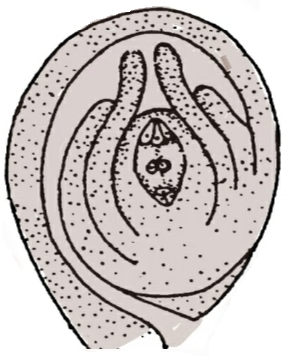
  1. Refer to the given figure and select the correct statement regarding it.
  1. This type of ovule is found in cactus.
  2. The micropyle comes to lie close to the funiculus due to unilateral growth of ovule.
  3. It is most common type of ovule found in the members of Chenopodiaceae.
  4. It is half inverted ovule.
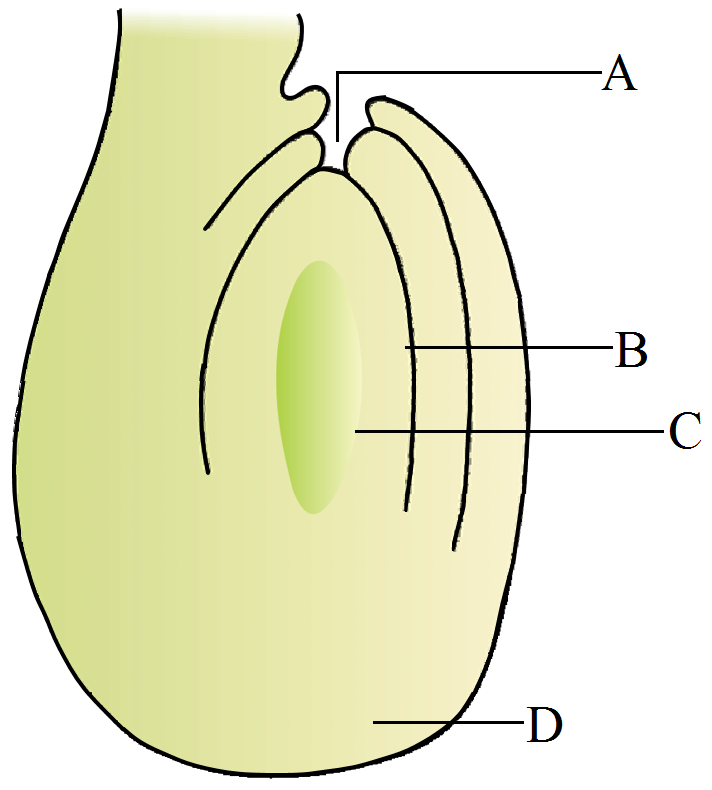
  1. Identify the parts labelled as $A, B, C$ and $D$ in the given figure and select the correct option.
S. No $A$ $B$ $C$ $D$
$(a)$ Chalaza Female gametophyte Embryo sac Micropyle
$(b)$ Chalaza NuceIIus Embryo sac Micropyle
$(c)$ Micropyle Egg Embryo sac Chalaza
$(d)$ Micropyle Nucellus Embryo sac Chalaza
  1. Mature ovules are classified on the basis of funiculus. If micropyle lie close to the funiculus, the ovule is termed as:
  1. Orthotropous.
  2. Anatropous.
  3. Hemitropous.
  4. Campylotropous.
  1. In Asphodel us, ovule is:
  1. Unitegmic.
  2. Tritegmic.
  3. Bitegmic.
  4. Ategmic.
Two statements are given$-$one labelled Assertion and the other labelled Reason. Select the correct answer to these questions from the codes $(a), (b), (c)$ and $(d)$ as given below.
Assertion: Immobilised yeasts cause less fermentation.
Reason: Brewer's yeast produces beer not wine.
For two statements are given$-$one labelled Assertion and the other labelled Reason. Select the correct answer to these questions from the codes $(a), (b), (c)$ and $(d)$ as given below.
Assertion: Megaspore mother cell undergoes meiotic division.
Reason: All four megaspores form female gametophyte.
Number of rice varieties developed by ancient Indians was :