MCQ
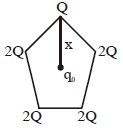
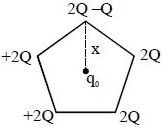
For regular pentagon system shown in figure, find force on $q_0$
  • $\frac{{KQ{q_0}}}{{{x^2}}}$
  • B
    $\frac{{2KQ{q_0}}}{{{x^2}}}$
  • C
    $\frac{{KQ{q_0}}}{{{2x^2}}}$
  • D
    zero

Answer

Correct option: A.
$\frac{{KQ{q_0}}}{{{x^2}}}$
a
force on  ${\rm{'}}{{\rm{q}}_0}'$

$\Rightarrow \mathrm{F}=\frac{\mathrm{KQ} \mathrm{q}_{0}}{\mathrm{x}^{2}}$
Need a full question paper?

Generate a complete, print-ready paper with questions like this in minutes — across 16+ boards, with answer keys.
Start Generating Free

Similar questions

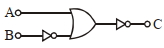
The logic circuit shown above is equivalent to :
A current $i$ is flowing in a conductor of length $l$. When it is bent in the form of a circular  loop then its magnetic moment will be-
When the momentum of a proton is changed by an amount $P_0$, the corresponding change in the de-Broglie wavelength is found to be $0.25\%$. Then, the original momentum of the proton was
If $A = 100101$ and $B = 110110$ are applied to $X-NOR$ gate, then the output will be
A balloon contains $1500 \,m^3$ of helium at $27^\circ C$ and $4$ atmospheric pressure. The value of helium at $ - \,3^\circ C$ temperature and $2$ atmospheric pressure will be ...... $m^3$
The magnitude of the $X$ and $Y$ component of $\vec A$ are $7$ and $6$ respectively. Also the magnitude of $X$ and $Y$ component of $\vec A + \vec B$ are $11$ and $9$ respectively. What is the magnitude of $\vec B$  ?
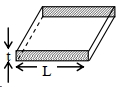
Consider a thin square sheet of side $\mathrm{L}$ and thickness $\mathrm{t}$, made of a material of resistivity $\rho$. The resistance between two opposite faces, shown by the shaded areas in the figure is
A car is travelling with linear velocity $v$ on a circular road of radius $r$. If it is increasing its speed at the rate of $'a'$ $meter/{\sec ^2}$, then the resultant acceleration will be
In case of an orbiting satellite, if the radius of orbit is decreased
A circular disk of radius R meter and mass M kg is rotating around the axis perpendicular to the disk. An external torque is applied to the disk such that $\theta( t )=5 t ^2-8 t$, where $\theta( t )$ is the angular position of the rotating disc as a function of time $t$.
How much power is delivered by the applied torque, when $t =2 s$ ?