MCQ
For saturated solution of $CaF_2$, choose the correct relationship-
  • A
    $\Lambda _{{m_{Ca{F_2}}}}^\infty  = \lambda _{e{q_{C{a^{2 + }}}}}^\infty  + 2\lambda _{e{q_{{F^\Theta }}}}^\infty$
  • $\Lambda _{{m_{Ca{F_2}}}}^\infty  = 2\left( {\lambda _{e{q_{C{a^{2 + }}}}}^\infty  + \lambda _{e{q_{{F^\Theta }}}}^\infty } \right)$
  • C
    $\Lambda _{{m_{Ca{F_2}}}}^\infty  = 2\left( {\lambda _{e{q_{C{a^{2 + }}}}}^\infty  + 2\lambda _{e{q_{{F^\Theta }}}}^\infty } \right)$
  • D
    $\Lambda _{{m_{Ca{F_2}}}}^\infty  = \frac{1}{2}\left( {\lambda _{e{q_{C{a^{2 + }}}}}^\infty  + \lambda _{e{q_{{F^\Theta }}}}^\infty } \right)$
Answer

Correct option: B.
$\Lambda _{{m_{Ca{F_2}}}}^\infty  = 2\left( {\lambda _{e{q_{C{a^{2 + }}}}}^\infty  + \lambda _{e{q_{{F^\Theta }}}}^\infty } \right)$
b

Need a full question paper?

Generate a complete, print-ready paper with questions like this in minutes — across 16+ boards, with answer keys.

Start Generating Free

Similar questions

Each of the following ion contains vanadium the $+ V$ oxidation state except
$p-$ Hydroxybenzophenone upon reaction with bromine in carbon tetrachloride gives
In nitration of benzene by mixed acide the rate of reaction will be
Which of these do not undergo Wurtz reaction
For reaction $A \to B$, the rate constant $k_1 = A_1    e^{-Ea_{1} /(RT)}$ and for the reaction $X \to Y$ the rate constant $k_2 = A_2 e^{-Ea_2 /(RT)}$ . If $A_1 = 10^{8}, \,\,A_2 = 10^{10}$ and $E_{a_1} = 600\ cal/mol$, $E_{a_2} = 1800\, cal/mol$, then the temperature at which $k_1 = k_2$ is (Given : $R = 2 \,cal/K-mol$)
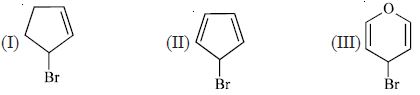
Among the bromides $I-III$ given below, the order of reactivity is $S_{N^{1}}$ reaction is :
If $x$ gram of non-volatile, non-electrolytic solute is dissolved in $114\  g$ octane to reduce its vapour pressure to $80\%$ of that of pure octane then $x$ is ........... $g$. (Molar mass solute $= 40\  g/mole$)
Which of the following is the best scientific method to test presence of water in a liquid
A $250.0\,mL$ sample of a $0.20\,M\,Cr^{3+}$ is electrolyzed with a current of $96.5\,A$ . If the remaining $[Cr^{3+}]$ is $0.1\,M$ the duration of process is .............. $\mathrm{s}$ (Atomic weight of $Cr = 52$ )
Among the complex ions, $\left[ Co \left( NH _2- CH _2- CH _2- NH _2\right)_2 Cl _2\right]^{+}, \quad\left[ CrCl _2\left( C _2 O _4\right)_2\right]^{3-},\left[ Fe \left( H _2 O \right)_4( OH )_2\right]^{+}$, $\left[ Fe \left( NH _3\right)_2( CN )_4\right]^{-},\left[ Co \left( NH _2- CH _2- CH _2- NH _2\right)_2\left( NH _3\right) Cl \right]^{2+}$ and $\left[ Co \left( NH _3\right)_4\left( H _2 O \right) C1 \right]^{2+}$, the number of complex ion$(s)$ that show$(s)$ cis-trans isomerism is