MCQ
For small currents, ‘X’ obeys Ohm’s law. But when large currents are passed through the same conductor, it deviates from ohmic behaviour. Identify X.
- AMetallic conductor.
- BGallium arsenide.
- CThyristor.
- Dp-n junction diode.
Explanation:
‘X’ is a metallic conductor. For small currents, it obeys Ohms’s law and its V-I graph is a straight line. But when large currents are passed through the same conductor, it gets heated up and its resistance increases. It no longer obeys Ohm’s law at higher currents.
Generate a complete, print-ready paper with questions like this in minutes — across 16+ boards, with answer keys.
An object is placed at a distance of f/2 from a convex lens. The image will be
|
(a) At one of the foci, virtual and double its size |
|
(b) At 3f / 2, real and inverted |
|
(c) At 2f, virtual and erect |
|
(d) None of these |
Under which of the following conditions will a convex mirror of focal length f produce an image that is erect, diminished and virtual
|
(a) Only when 2f > u > f |
(b) Only when u = f |
|
(c) Only when u < f |
(d) Always |
When an inert gas is filled in the place vacuum in a photo cell, then
|
(a) Photo-electric current is decreased |
|
(b) Photo-electric current is increased |
|
(c) Photo-electric current remains the same |
|
(d) Decrease or increase in photo-electric current does not depend upon the gas filled |
Two voltameters, one of copper and another of silver, are joined in parallel. When a total charge q flows through the voltameters, equal amount of metals are deposited. If the electrochemical equivalents of copper and silver are  and
and  respectively the charge which flows through the silver voltameter is
|
(a) |
(b) |
(c) |
(d) |
A free neutron decays into a proton, an electron and
|
(a) A neutrino |
(b) An antineutrino |
(c) An alpha particle |
(d) A beta particle |
Potential difference across the terminals of the battery shown in figure is (r = internal resistance of battery)
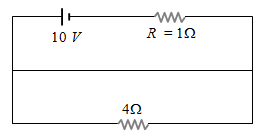
|
(a) 8 V |
(b) 10 V |
(c) 6 V |
(d) Zero |


