Question
For sound waves, the Doppler formula for frequency shift differs slightly between the two situations: (i) source at rest; observer moving, and (ii) source moving; observer at rest. The exact Doppler formulas for the case of light waves in vacuum are, however, strictly identical for these situations. Explain why this should be so. Would you expect the formulas to be strictly identical for the two situations in case of light travelling in a medium?
Answer

Sound waves require a medium for propagation. Thus, even though both the situations may correspond to the same relative motion (between the source and the observer), they are not identical physically since, the motion of the observer, relative to the medium is different in the two situations. Therefore, we cannot expect Doppler formulas for sound to be identical for (i) and (ii).
For light waves in vacuum, there is clearly nothing to distinguish between two cases given. Here only the relative motion between the source and the observer counts and the relativistic Doppler formula is the same for both cases. For light propagation in a medium, once again like for sound waves, the two situations are not identical and we should expect the Doppler formulas for this case to be different for the two situations (i) and (ii).

Need a full question paper?

Generate a complete, print-ready paper with questions like this in minutes — across 16+ boards, with answer keys.

Start Generating Free

Similar questions

Write Einstein's Photoelectric equation and mention which important features in photoelectric effect can be explained with the help of this equation.
The maximum kinetic energy of the photoelectrons gets doubled when the wavelength of light incident on the surface changes from $\lambda_{1}$to $\lambda_{2}$. Derive the expressions for the threshold wavelength $\lambda_{\circ}$ and work function for the metal surface.
Give a circuit diagram of a common emitter amplifier using an n-p-n transistor. Draw the input and output waveforms of the signal. Write the expression for its voltage gain.
Write first rule of Kirchhoff (junction rule).By drawing circuit diagram of Wheatstone Bridge, obtain condition for zero deflection in the bridge.
A concave mirror has a focal length of 20cm. Find the position or positions of an object for which the imagesize is double of the object-size.
The work function for a certain metal is 4.2 eV. Will this metal give photoelectric emission for incident radiation of wavelength 330 nm?
A point charge of 2.0 μC is at the centre of a cubic Gaussian surface 9.0 cm on edge. What is the net electric flux through the surface?
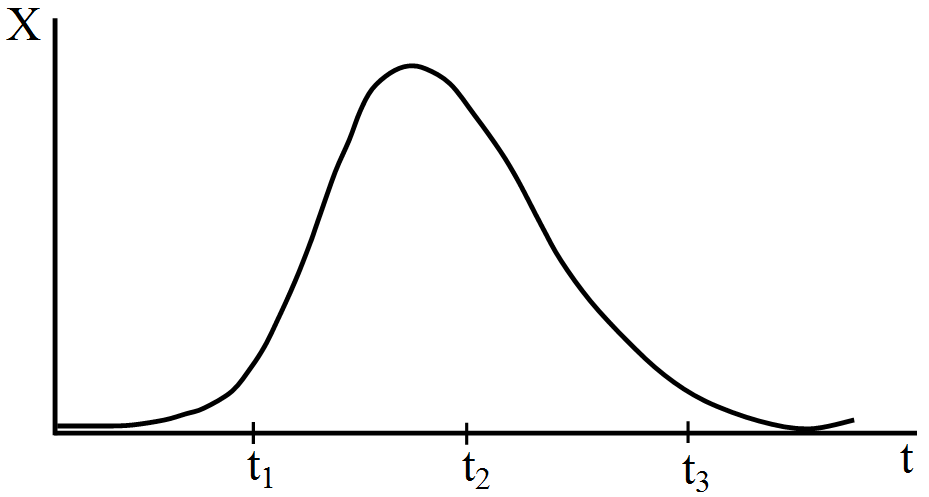
Figure shows the x coordinate of a particle as a function of time. Find the signs of $v_x$ and $a_x$ at $t = t_1, t = t_2$ and $t = t_3.$
In a Wheatstone bridge, $P =1 \Omega, Q =2 \Omega, R =2 \Omega, S=3 \Omega$ and $R _{ g }=4 \Omega$. Find the current through the galvanometer in the unbalanced position of the bridge, when a battery of 2 V and internal resistance $2 \Omega$ is used.
Is $\text{p}=\frac{\text{E}}{\text{c}}$ valid for electrons?
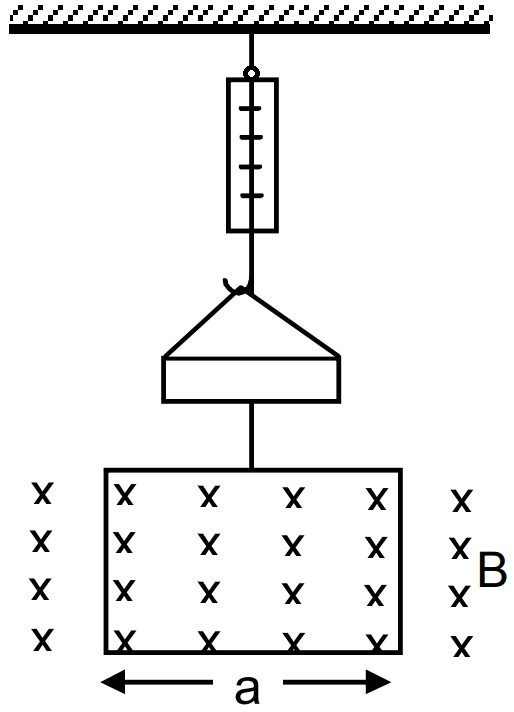
A rectangular wire loop of width a is suspended from the insulated pan of a spring balance, as shown in A current i exists in the anti-clockwise direction in the loop. A magnetic field Bexists in the lower region. Find the change in the tension of the spring if the current in the loop is reversed.