MCQ
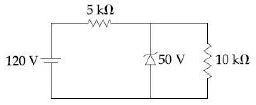
For the circuit shown below, the current through the Zener diode is......$mA$
  • $9$
  • B
    $5$
  • C
    $0$
  • D
    $14$

Answer

Correct option: A.
$9$
a
$\mathrm{I}_{10 \mathrm{k}}=\frac{50}{10 \mathrm{k}}=5\, \mathrm{mA}$

$\mathrm{i}_{5 \mathrm{k}}=\frac{120-50}{5 \mathrm{k}}=14\, \mathrm{mA}$

$\mathrm{i}_{2}=(14-5) \mathrm{mA}=9\, \mathrm{mA}$

Need a full question paper?

Generate a complete, print-ready paper with questions like this in minutes — across 16+ boards, with answer keys.
Start Generating Free

Similar questions

Two exactly similar wires of steel and copper are stretched by equal forces. If the total elongation is $2 \ cm$, then how much is the elongation in steel and copper wire respectively? Given, $Y_{\text {steel }}=20 \times 10^{11} dyne / \ cm ^2, Y_{\text {copper }}=12 \times 10^{11} dyne / \ cm ^2$
A time varying current $i$ is passed through a resistance $R$ as shown in figure. The total heat generated in the resistance is
A cricket ball of mass $0.15\, kg$ is thrown vertically up by a bowling machine so that it rises to a maximum height of $20 \;m$ after leaving the machine. If the part pushing the ball applies a constant force $F$ on the ball and moves horizontally a distance of $0.2\, m$ while launching the ball, the value of $F($ in $N)$ is 

$\left(g=10\, m s^{-2}\right)$

A horizontal straight conductor kept in north-south direction falls under gravity, then
The magnetic field at point, point $P$ will be :-
If $r$ represents the radius of the orbit of a satellite of mass $m$ moving around a planet of mass $ M$, the velocity of the satellite is given by
A thin uniform rod of length $l$ and mass $m$ is swinging freely about a horizontal axis passing through its end. Its maximum angular speed is $\omega $. Its centre of mass rises to a maximum height of
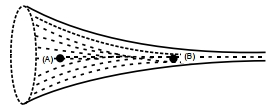
The figure shows a liquid of given density flowing steadily in horizontal tube of varying cross-section. Cross sectional areas at $A$ is $1.5\,cm ^2$, and $B$ is $25\,mm ^2$, if the speed of liquid at $B$ is $60\,cm / s$ then $\left( P _{ A }- P _{ B }\right)$ is :(Given $P _{ A }$ and $P _{ B }$ are liquid pressures at $A$ and $B$ points.Density $\rho=1000\,kg\,m ^{-3}$

$A$ and $B$ are on the axis of tube $............\,Pa$
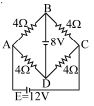
The given figure shows $a$ network of resistances and $a$ battery. Which of the two batteries is getting charged?
Durring Searle's experiment, zero of the Vernier scale lies between $3.20 \times 10^{-2} m$ and $3.25 \times 10^{-2} m$ of the main scale. The $20^{\text {th }}$ division of the Vernier scale exactly coincides with one of the main scale divisions. When an additional load of $2 \ kg$ is applied to the wire, the zero of the Vernier scale still lies between $3.20 \times 10^{-2} m$ and $3.25 \times 10^{-2} m$ of the main scale but now the $45^{\text {th }}$ division of Vernier scale coincides with one of the main scale divisions. The length of the thin metallic wire is $2 m$. and its cross-sectional area is $8 \times 10^{-7} m ^2$. The least count of the Vernier scale is $1.0 \times 10^{-5} m$. The maximum percentage error in the Young's modulus of the wire is