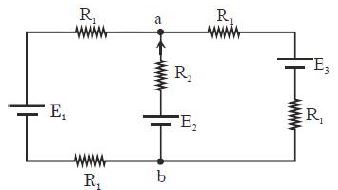
For the circuit shown, with ${R_1} = 1.0\,\Omega $, ${R_2} = 2.0\,\Omega $, ${E_1} = 2\,V$ and ${E_2} = {E_3} = 4\,V$, the potential difference between the points $‘a’$ and $‘b’$ is approximately (in $V$)
A$3.3$
B$2.3$
C$3.7$
D$2.7$
JEE MAIN 2019, Medium
Download our app for free and get started
A$3.3$
a $ E_{e q}= \frac{\frac{E_{1}}{2 R_{1}}+\frac{E_{2}}{R_{2}}+\frac{E_{3}}{2 R_{1}}}{\frac{1}{2 R_{1}}+\frac{1}{R_{2}}+\frac{1}{2 R_{1}}} $
Experience the future of education. Simply download our apps or reach out to us for more information. Let's shape the future of learning together!No signup needed.*
An infinite line charge of uniform electric charge density i. lies along the axis of an electrically conducting infinite cylindrical shell of radius $R$. At time $t=0$, the space inside the cylinder is filled with a material of permittivity $\varepsilon$ and electrical conductivity $\sigma$. The electrical conduction in the material follows Ohm's law. Which one of the following graphs best describes the subsequent variation of the magnitude of current censity $j(t)$ at any point in the material?
Three resistances, each of $1\, ohm$, are joined in parallel. Three such combinations are put in series, then the resultant resistance will be ............. $ohm$
A $3\, volt$ battery with negligible internal resistance is connected in a circuit as shown in the figure. The current $I$, in the circuit will be ............. $A$
The circuit below is used to heat water kept in a bucket. Assuming heat loss only by Newton's law of cooling, the variation in the temperature of the water in the bucket as a function of time is depicted by
A rectangular parallelopiped is measured as $1\,cm \times 1\,cm \times 100\,cm$. If its specific resistance is $3 \times 10^{-7}\,\Omega\,m$, then the resistance between its two opposite rectangular faces will be $..........x^{-7} \Omega$.
In the given circuit the internal resistance of the $18\,V$ cell is negligible. If $R_1 = 400 \,\Omega ,\,R_3 = 100\,\Omega $ and $R_4 = 500\,\Omega $ and the reading of an ideal voltmeter across $R_4$ is $5\,V,$ then the value of $R_2$ will be ........... $\Omega$
A wire of length $L$ and $3$ identical cells of negligible internal resistances are connected in series. Due to current, the temperature of the wire is raised by $\Delta T$ in a time $t$. A number $N$ of similar cells is now connected in series with a wire of the same material and cross-section but of length $2\, L$. The temperature of the wire is raised by the same amount $\Delta T$ in the same time $t$. the value of $N$ is
Two indentical electric lamps marked $500\, W, \,\,220\, V$ are connected in series and then joined to a $110\, V$ line. The power consumed by each lamp is