MCQ
For the diode, the characteristic curves are given at different temperature. The relation between the temperatures is
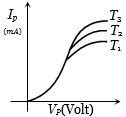
- A${T_1} = {T_2} = {T_3}$
- ✓${T_1} < {T_2} < {T_3}$
- C${T_1} > {T_2} > {T_3}$
- DNone of the above
Generate a complete, print-ready paper with questions like this in minutes — across 16+ boards, with answer keys.
$(A)$ $\mathrm{C}_{\mathrm{p}}-\mathrm{C}_{\mathrm{v}}$ is larger for a diatomic ideal gas than for a monoatomic ideal gas
$(B)$ $\mathrm{C}_{\mathrm{p}}+\mathrm{C}_{\mathrm{v}}$ is larger for a diatomic ideal gas than for a monoatomic ideal gas
$(C)$ $\mathrm{C}_{\mathrm{p}} / \mathrm{C}_{\mathrm{v}}$ is larger for a diatomic ideal gas than for a monoatomic ideal gas
$(D)$ $\mathrm{C}_{\mathrm{p}} \cdot \mathrm{C}_v$ is larger for a diatomic ideal gas than for a monoatomic ideal gas
Due to the presence of the current $I_1$ at the origin