MCQ
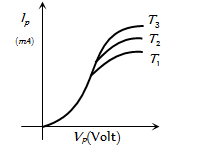
For the diode, the characteristic curves are given at different temperature. The relation between the temperatures is
  • A
    $T _1= T _2= T _3$
  • $T _1< T _2< T _3$
  • C
    $T _1> T _2> T _3$
  • D
    None of the above

Answer

Correct option: B.
$T _1< T _2< T _3$
$T _1< T _2< T _3$

Need a full question paper?

Generate a complete, print-ready paper with questions like this in minutes — across 16+ boards, with answer keys.
Start Generating Free

Similar questions

Hydrogen has________ isotopes. 
de-Broglie wavelength ($ \lambda $) of different particles having same kinetic energy depends on their mass as :
A lens of focal power 0.5 D is(a) A convex lens of focal length 0.5 m(b) A concave lens of focal length 0.5 m(c) A convex lens of focal length 2 m(d) A concave lens of focal length 2 m


Taking Rydberg’s constant $R_H=1.097\times 10^7m$ first and second wavelength of Balmer series in hydrogen spectrum is
To draw a maximum current from a combination of cells, how should the cells be grouped?
Six charges, three positive and three negative of equal magnitude are to be placed at the vertices of a regular hexagon such that the electric field at $\text{O}$ is double the electric field when only one positive charge of same magnitude is placed at $\text{R}$. Which of the following arrangements of charges is possible for $\text{P, Q, R, S, T}$ and $\text{U}$ respectively
Which of the following of a radioactive material is a measure of its instability?
A galvanometer, having a resistance of $50 \Omega$ gives a full scale deflection for a current of $0.05 A$. The length in meter of a resistance wire of area of cross$-$section $2.97 \times 10^{–2} \ cm^2$ that can be used to convert the galvanometer into an ammeter which can read a maximum of $5 A$ current is $($Specific resistance of the wire $= 5 \times 10^{-7} Wm)$
The refraction of light is commonly known as:
To demonstrate the phenomenon of interference, we require two sources which emit radiation(a) Of the same frequency and having a define phase relationship(b) Of nearly the same frequency(c) Of the same frequency (d) Of different wavelengths