MCQ
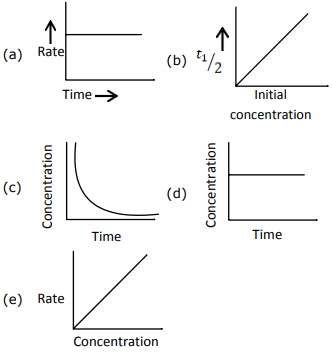
For the following graphs,

Choose from the options given below, the correct one regarding order of reaction is:
  • A
    $(b)$ and $(d)$ Zero order $(e)$ First order
  • B
    $(a)$ and $(b)$ Zero order $(c)$ and $(e)$ First order
  • $(a)$ and $(b)$ Zero order $(e)$ First order
  • D
    $(b)$ Zero order $(c)$ and $(e)$ First order

Answer

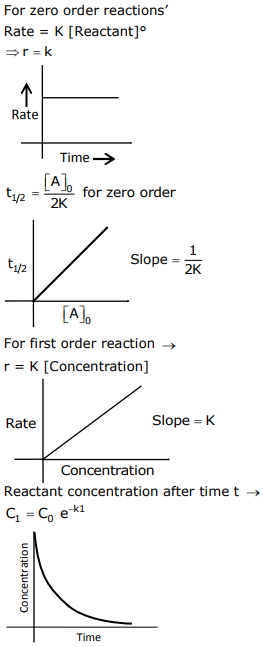
Correct option: C.
$(a)$ and $(b)$ Zero order $(e)$ First order
c

Need a full question paper?

Generate a complete, print-ready paper with questions like this in minutes — across 16+ boards, with answer keys.

Start Generating Free

Similar questions

Arrange the following in order of their reactivity toward decarboxylation reaction

$\mathop {\begin{array}{*{20}{c}}
{\,\,\,\,\,\,\,\,\,\,\,\,\,\,O}\\
{\,\,\,\,\,\,\,\,\,\,\,\,\,\,||}\\
{CH \equiv C - C - OH}
\end{array}}\limits_{\rm{I}} $ $\mathop {\begin{array}{*{20}{c}}
{\,\,\,\,\,\,\,\,\,\,\,\,\,\,\,\,\,\,\,O}\\
{\,\,\,\,\,\,\,\,\,\,\,\,\,\,\,\,\,\,\,||}\\
{C{H_2} = CH - C - OH}
\end{array}}\limits_{{\rm{II}}} $ $\mathop {\begin{array}{*{20}{c}}
{\,\,\,\,\,\,\,\,\,\,\,\,\,\,\,\,\,\,\,O}\\
{\,\,\,\,\,\,\,\,\,\,\,\,\,\,\,\,\,\,\,||}\\
{C{H_3} - C{H_2} - C - OH}
\end{array}}\limits_{{\rm{III}}} $$\mathop {\begin{array}{*{20}{c}}
\,\,\,{C{H_3}\,\,\,\,\,\,O}\\
\,\,\,{|\,\,\,\,\,\,\,\,\,\,\,\,\,\,\,||}\\
{C{H_3} - CH - C - OH}
\end{array}}\limits_{{\rm{IV}}} $

Which of the following cannot be represented by resonance structures?
Out of the following fractions of petroleum, the one having the lowest boiling point is or Which of the following is obtained at lowest temperature by fractional distillation of petroleum
If $900\,J/g$ of heat is exchanged at boiling point of water, then what is increase in entropy.......$J/mole$
A binary liquid solution is prepared by mixing $n-$ heptaneand ethanol. Which one of the following statements is correct regarding the behaviour of the solution ?
Find the ions which do not have X-O-X type of linkage:
The atomic weight of $Fe$ is $56.$  The weight of $Fe$ deposited from $FeC{l_3}$ solution by passing $0.6$ Faraday of electricity is ............. $\mathrm{g}$
Which of the following trivalent ion has the largest atomic radii in the lanthanide series
Compound $A$ is converted to $B$ on reaction with $\mathrm{CHCl}_{3}$ and $\mathrm{KOH}$. The compound $\mathrm{B}$ is toxic and can be decomposed by $C.$ $A, B$ and $C$ respectively are :
$116\, g$ of a substance upon dissociation reaction, yields $7.5 \,g$ of hydrogen, $60 \,g$ of oxygen and $48.5\, g$ of carbon. Given that the atomic masses of $H , O$ and $C$ are $1,16$ and $12$ respectively. The data agrees with how many formulae of the following?

$(A)$ $CH _{3} COOH$

$(B)$ $HCHO$

$(C)$ $CH _{3} OOCH _{3}$

$(D)$ $CH _{3} CHO$